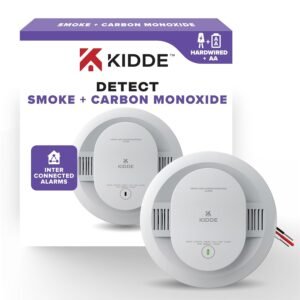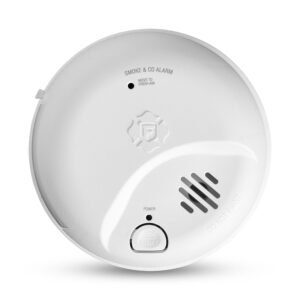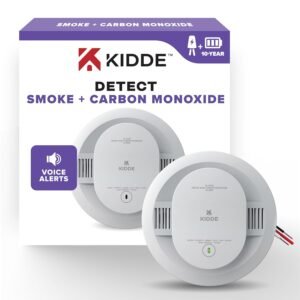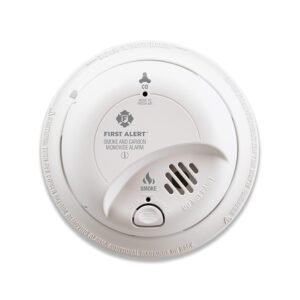
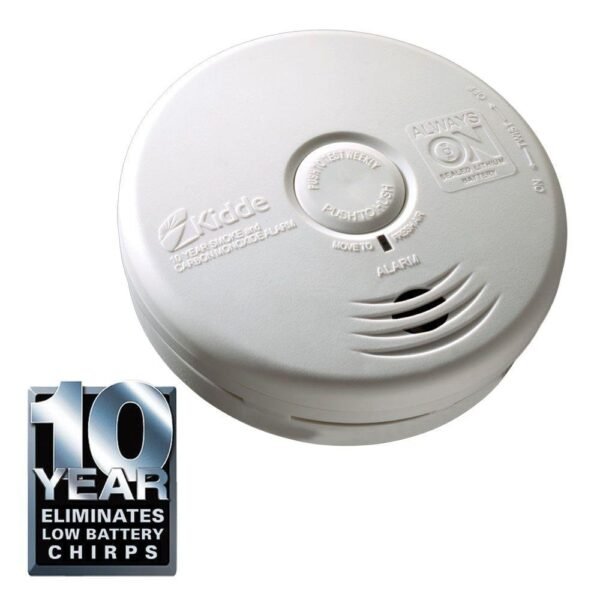








Description
Positive Features of the Kidde Kitchen Smoke and Carbon Monoxide Alarm
The Kidde P3010K-CO Worry-Free Kitchen Photoelectric Smoke and Carbon Monoxide Alarm is aimed at the hardest room in the house to alarm. Its defining specification is the sealed-in 10-year lithium battery, which removes the periodic battery change and the flat-cell chirp that leads people to pull alarms down. The photoelectric sensor technology is the reason it carries a kitchen designation: photoelectric sensing responds to the visible particles of a developing fire and is markedly less reactive to cooking aerosols and steam than ionization sensing, which is the sensor type behind most kitchen nuisance alarms.
- 10-year sealed lithium battery removes battery changes for the life of the unit
- Combination of smoke and carbon monoxide detection in one unit
- 85dB piezoelectric horn, the standard residential alarm output
- Tamper-resistant design discourages casual removal
- End-of-life signal flags when the unit needs replacing
The hush feature covers the burnt-toast case directly, silencing a nuisance activation temporarily instead of requiring the alarm to be disabled. The housing is compact for a combination unit, and the mounting bracket activates the alarm as it is attached, so a unit cannot be left mounted but switched off. Households wanting the same sealed-cell arrangement without carbon monoxide detection can compare the living area photoelectric version of this alarm.
Areas for Improvement Worth Considering
A few characteristics deserve attention. The end-of-life signal is deliberately persistent and is easy to misread as a low battery warning on a sealed unit where no battery can be changed. The single test/reset button carries several functions, which is not self-explanatory when somebody is trying to silence an alarm quickly.
One point in the listing needs clarifying rather than repeating: the alarm is described as maintenance free, which refers to battery replacement only. Kidde still specifies a weekly push-button test, and the sealed cell does not change that. An alarm that is never tested is not a maintained alarm, whatever the battery arrangement.
- End-of-life warning can sound at inconvenient hours
- The combined test/reset button is not intuitive on first use
- No wireless interconnect, so alarms cannot sound together across a larger home
- The alarm is battery powered only, with no hardwired option
- Priced above basic smoke-only alarms
The absence of interconnect suits smaller homes and flats where wiring is impractical. In a larger or multi-storey property the lack of linking is the main limitation, since an alarm sounding in an empty kitchen may not be heard upstairs.
Design and Installation Simplicity
The design is tailored to kitchens, where cooking smoke is routine and disabling an alarm is a live risk. The photoelectric sensor registers smoke particles while being less reactive to steam and frying vapour, which is what reduces nuisance activations relative to ionization units. Listed dimensions are 5.22 x 5.22 x 1.6 inches, unobtrusive but visible enough to be checked.
Installation involves no wiring. The mounting bracket attaches to the ceiling and the alarm activates on being seated, removing the most common commissioning error. The tamper-resistant feature makes removal deliberate rather than casual. Kitchen alarm placement is worth checking against local code and Kidde’s instructions, since siting an alarm too close to a cooker undermines even a photoelectric sensor.
Performance and Sensor Coverage
A fair question about any combination alarm is whether both sensors are equally suited to their hazard. Here the photoelectric smoke sensor is the appropriate choice for smouldering fires and for a kitchen setting, and the carbon monoxide side runs on a separate sensing element responding to CO specifically rather than to combustion products generally. The two hazards are unrelated in origin, and covering both from one position is the design argument for the unit.
The 85dB horn is the standard residential output, specified at 10 feet. That figure matters for carbon monoxide in particular, because CO gives no sensory warning at the concentrations that cause harm, so the alarm is the only signal. The unit uses distinct alert patterns for smoke and for CO, which matters because the correct response differs: a fire alarm means leave the building, while a CO alarm means get everyone into fresh air and have the appliance investigated. Neither response is optional, and neither is something the alarm itself performs.
Value Assessment: Is It Worth the Investment?
Weighing the combined smoke and CO detection, the 10-year sealed battery, and the kitchen-oriented sensor together, the price is consistent with the category. The relevant comparison is against a smoke alarm plus a separate CO alarm, which means two units, two positions, and two replacement cycles. Over a decade the sealed cell also removes the recurring battery cost and the chirp that prompts people to disconnect alarms.
Against cheaper units, the argument is fewer nuisance alarms, which is a safety outcome rather than a convenience one: an alarm that cries wolf in a kitchen is an alarm that gets taken down. The 10-year limited warranty runs alongside the sealed cell. A directly comparable sealed combination unit is the Kidde P3010CU with voice alerts.
Product Comparisons: How It Stacks Up Against Rivals
Set against First Alert’s combination alarms or Nest Protect, this Kidde leads on the sealed 10-year battery, which not all competitors match. Its photoelectric sensing is specified for kitchen use, where rivals relying on ionization sensors are more prone to cooking activations.
Smart alarms such as Nest Protect add wireless interconnection and phone notification, neither present here. For remote monitoring or home automation integration, those competitors are the better fit. For buyers who want detection without an account, a network dependency, or a firmware cycle attached to a life safety device, the simplicity is the point. Two other options in the same class are the X-Sense SC07 combination alarm and the First Alert SMCO210.
Where This Alarm Fits
The strongest case for this unit is a kitchen or an adjacent hallway in a home without alarm wiring, where a photoelectric sensor and a decade of sealed power remove both the nuisance-alarm problem and the maintenance problem in one purchase. Carbon monoxide coverage from the same position is a genuine addition rather than a bundled extra, given that CO is undetectable without an instrument.
The sealed design removes the forgotten battery change that disables so many alarms in practice. It does not remove the weekly test, the end-of-life replacement, or the requirements local code sets for how many alarms a dwelling needs and where they go.
Downsides That Might Influence Your Choice
The lack of wireless interconnection is the most consequential limitation, particularly in multi-storey homes where an alarm in one room does not sound the others. That delay is exactly what interconnected systems exist to remove. The end-of-life chirps can prompt people to disable a unit rather than replace it, which is the worst available outcome.
Price will deter buyers who only want basic smoke detection, and there is no smart home integration for remote alerts. Within those limits the alarm covers both hazards without ongoing battery maintenance. The wider combination smoke and carbon monoxide detector category covers the hardwired and interconnected alternatives for anyone who needs alarms to sound together.