

Description
Good Aspects of the Kidde Hardwired Smoke & Carbon Monoxide Detector
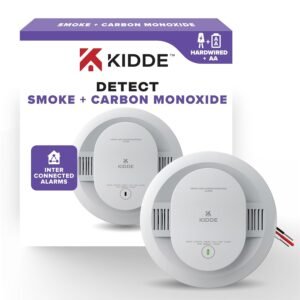
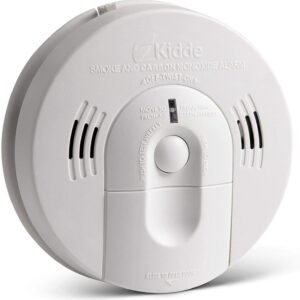
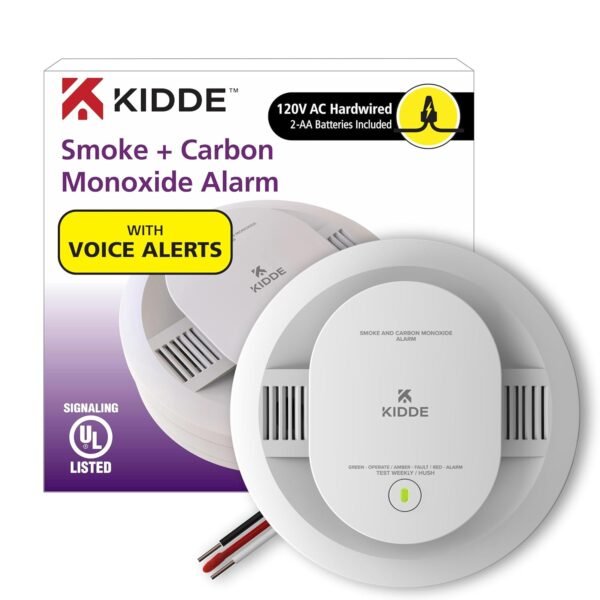
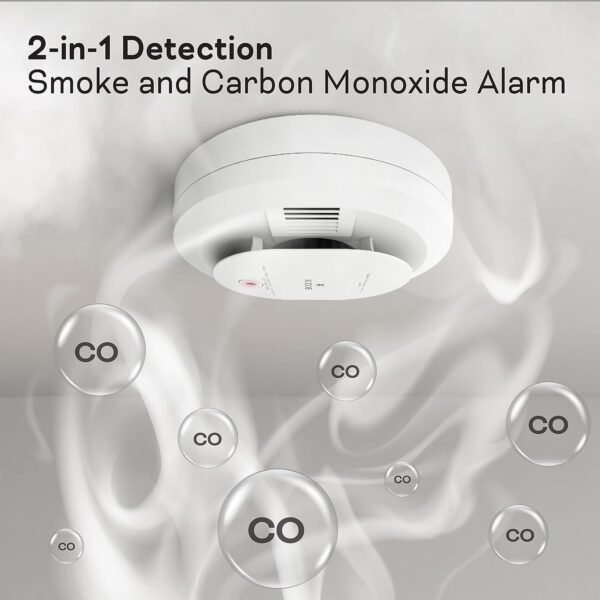
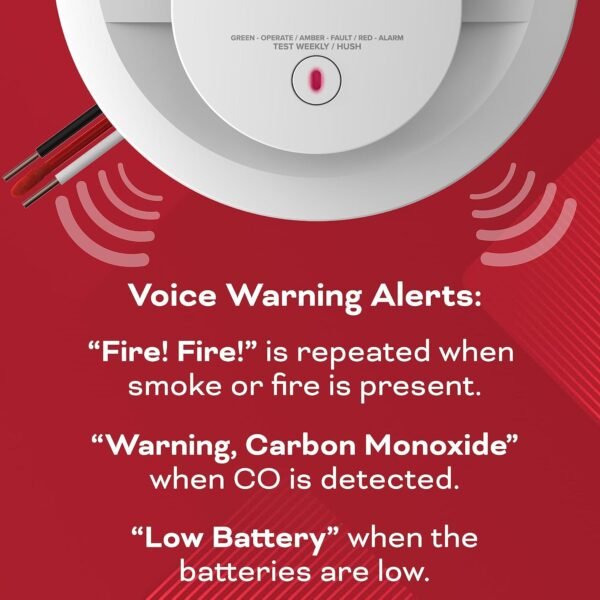
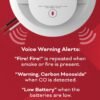
The Kidde Hardwired Smoke & Carbon Monoxide Detector, model 900-CUAR-V, is a mains-powered combination alarm. Its central specification is 2-IN-1 detection, covering both smoke and carbon monoxide from a single position. That saves a mounting point and a second purchase, though it does not change how many alarms a dwelling is required to have. The voice alerts announce “Fire!” or “Warning! Carbon Monoxide!” rather than leaving a beep pattern to be interpreted, which matters because the correct response to those two warnings is not the same.
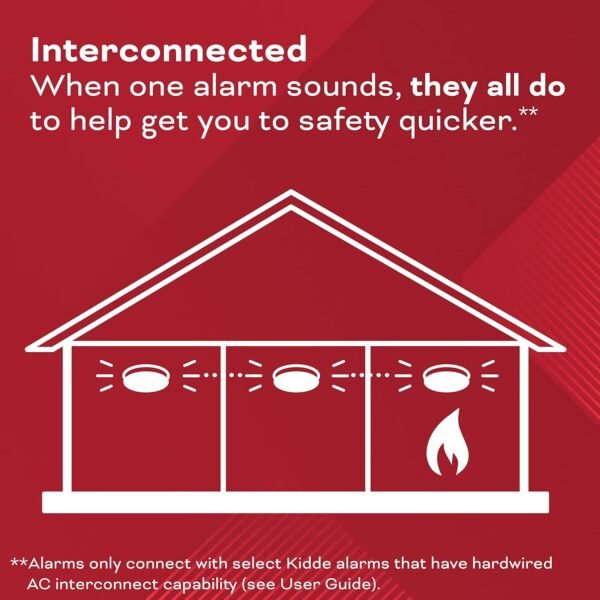
The unit runs from 120V AC wiring with 2 AA batteries for backup power, so it keeps monitoring through a mains failure. That is the scenario worth planning for, since outages are when generators, candles, and portable heaters come into use. A photoelectric sensor covers smouldering fires while an electrochemical sensor handles carbon monoxide, pairing each hazard with the sensing method suited to it. The interconnect capability sounds every linked alarm when any one of them triggers, which is the feature that matters most in a house where a bedroom is two floors from the kitchen. The non-voice sibling in the same family is covered in our Kidde 900-CUAR writeup.
- Dual smoke and carbon monoxide detection
- AA battery backup during mains failure
- Voice alerts that name the hazard
Drawbacks to Consider
Several limitations are worth weighing. The interconnect works only with select Kidde alarms that support hardwired AC interconnection, so brands cannot be mixed on one loop. For a household already running another manufacturer’s alarms elsewhere, that means replacing the loop rather than extending it. The housing, at roughly 5.6 inches across and 2 inches deep, is large for a ceiling fitting and is noticeable on a low ceiling.
The amber LED signals a fault or a connection problem but does not identify which, so diagnosis means going to the manual. That is a real friction point for anyone not comfortable with wiring, and a flashing amber light on a life safety device is not something to leave unresolved. The supplied backup cells are alkaline AA batteries, which need periodic replacement and add a small recurring cost over the alarm’s life.
- Interconnect limited to compatible Kidde alarms
- Large housing for tight ceiling spaces
- Amber fault LED does not identify the fault
Sensor Technology and Alarm Performance
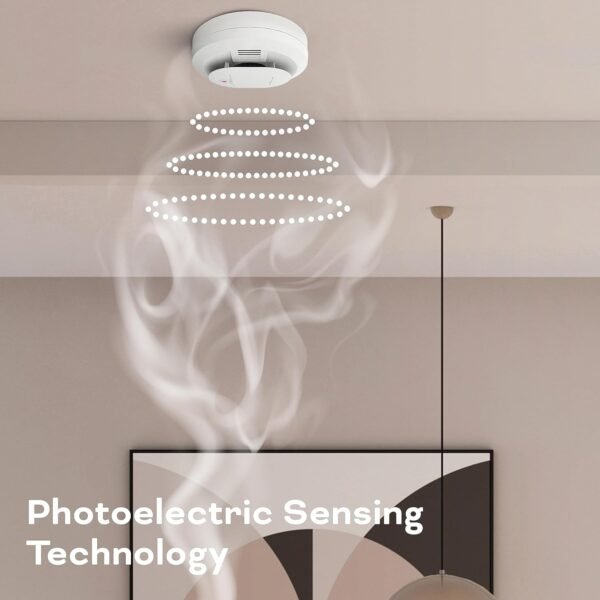
The alarm uses photoelectric sensing for smoke, the method oriented to the visible particles of smouldering fires and the one less reactive to cooking aerosols and steam than ionization sensing. That sensor choice is the main reason a combination alarm can be sited nearer a kitchen without constant nuisance activations, though proximity to a cooker still matters and is addressed by local code and Kidde’s instructions. The electrochemical sensor responds to carbon monoxide specifically rather than to combustion products generally.
The 85-decibel alarm output is the standard rating for residential alarms, measured at 10 feet. The voice alerts remove the ambiguity of a tone pattern, which is the practical argument for this variant over a non-speaking one. The Smart-Hush button silences a nuisance activation for about 8 minutes, long enough for a room to clear without the alarm being taken out of service. Silencing rather than disabling is the behaviour that keeps alarms working, and it is worth comparing against the approach taken by the Kidde 30CUAR with its false alarm reduction.
Installation and Usability
Fitting the alarm is mains electrical work, since it is hardwired into the 120V AC supply. The manual is detailed, but the installation must follow local electrical code and belongs with a qualified electrician wherever the existing wiring is uncertain. An incorrectly wired alarm can sit on a ceiling looking installed while carrying no power, which the green LED exists to rule out.
The white housing is conventional, though large as noted. Self-testing continuously checks internal components, but Kidde still specifies a weekly press of the test button, and the self-test does not replace it. The three LED indicators, green for normal operation, amber for faults, and red for alarm, give status at a glance. The 10-year limited warranty runs alongside an end-of-life announcement, “Replace Alarm!”, which is clearer than the chirp most alarms use for the same purpose and less likely to be mistaken for a low battery.
Alternative Offerings in the Market
Against the First Alert BRK 3120B or Nest Protect, the differences are clear. Nest Protect adds app integration and phone notification, which this Kidde does not have. The Kidde competes on price and on delivering a hardwired installation with battery backup in a single combination unit. First Alert’s comparable models are reliable but several use ionization sensing, which is more prone to cooking activations than the photoelectric sensor here. A directly comparable First Alert combination alarm is the SC9120B.
The listing states conformance with UL 217 9th Edition and UL 2034 4th Edition. Those are the current standards for smoke alarms and carbon monoxide alarms respectively, and conformance reflects testing by the certifying body rather than any assessment made here. Without smart home integration, the unit’s argument rests on straightforward operation and a wired interconnect.
Price Worthiness and Value Proposition
On value for money, this alarm is competitive. It covers two hazards in one device, so the comparison is against buying a smoke alarm and a CO alarm separately, with two positions and two replacement cycles. Battery backup and voice alerts are included at a price that generally undercuts connected detectors.
The absence of wireless interconnect or app control rules it out for buyers who want remote notification. What it does instead is signal a hazard clearly and loudly at the point it occurs, and sound every linked alarm at the same time. Given the 10-year service life and the limited warranty, the cost per year is modest. Similar hardwired combination options are covered in our Kidde KN-COSM-IBA review.
Downsides Affecting User Experience
The fault indicator LED is the most common source of confusion, because the troubleshooting steps are technical and the light does not say what is wrong. Buyers without electrical experience should expect to call an electrician rather than work through it. The alkaline backup batteries mean keeping replacements on hand, a small recurring task that sealed-cell alarms avoid entirely.
The interconnect limitation is the sticking point for anyone upgrading a mixed system. Where another brand is already installed, achieving a fully linked set of alarms may mean replacing all of them, which changes the cost calculation considerably.
Perks That Make It Stand Out
- Voice alerts name the hazard rather than coding it as beeps
- Smart-Hush silences nuisance alarms without disabling the unit
- Continuous self-testing alongside the weekly manual test
- Wired interconnect sounds every linked alarm together
This is a conventional hardwired combination alarm whose strengths are photoelectric smoke sensing, spoken hazard announcements, and a wired interconnect. Its weaknesses are the closed interconnect ecosystem and the uninformative fault LED. Placement, alarm count, and interconnect requirements are set by local building and fire code and by Kidde’s installation instructions, not by any recommendation here. The rest of the combination smoke and carbon monoxide detector category covers the sealed-battery alternatives for homes without alarm wiring.