



Description
Highlights of the Kidde Hardwired Smoke & Carbon Monoxide Detector
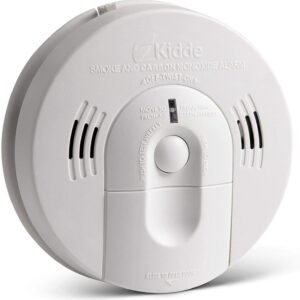
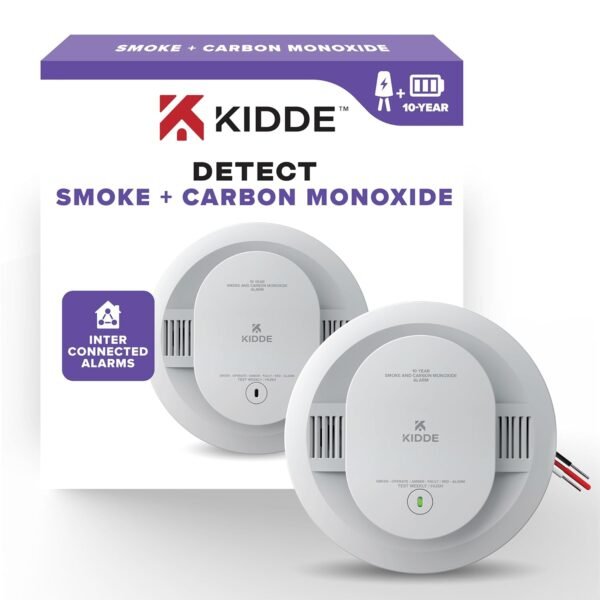
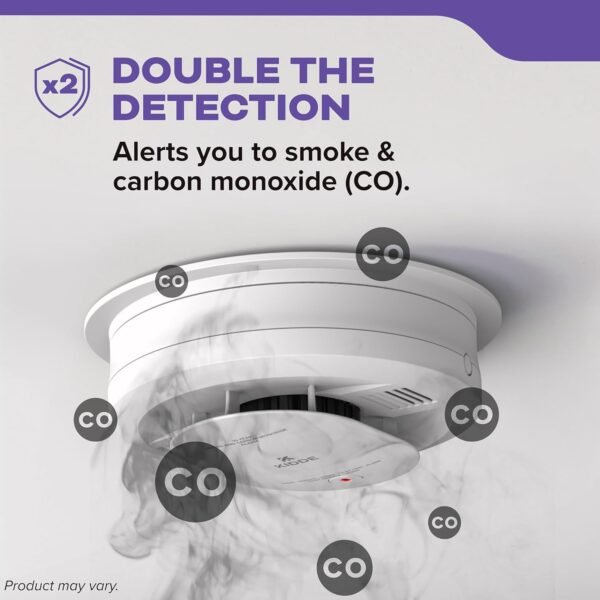
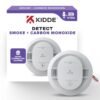
The Kidde Hardwired Smoke & Carbon Monoxide Detector, 10-Year Battery Backup, Interconnectable LED Warning Light Indicators (model 30CUA10) is built around a dual-function design, putting smoke sensing and carbon monoxide sensing at one ceiling position instead of two. The hardwired supply with a 10-year lithium battery backup is the combination that matters here: mains power runs the sensors, and the sealed cell carries the alarm through an outage without an annual battery task attached. Kidde specifies enhanced sensing technology aimed at cutting the cooking-related false alarms that get detectors disabled. A twist-and-click mounting bracket handles the physical fitting, and the interconnect capability means one triggered unit sounds every alarm on the loop, which is the point of a hardwired installation in a house with bedrooms on another floor.
- Detects both smoke and carbon monoxide with one device
- 10-year battery backup eliminates frequent battery changes
- Interconnectable alarms sound together across the property
- Reduced false alarms due to advanced sensing tech
Drawbacks to Keep in Mind
This alarm has real limits. Installation involves mains wiring, so the breaker goes off first and the work follows local electrical code, which for many households means booking an electrician rather than a Saturday afternoon. The 85-decibel horn is loud, and loud is not the same as certain to rouse every sleeper, which is why placement relative to bedrooms is a code question rather than a preference. The LED indicators take some learning, since green, amber and red each carry a different meaning and the manual is not always clear about which state is which. The self-test function is not a substitute for weekly manual testing, a point worth repeating because the presence of an automatic check is exactly what makes households stop pressing the button. The housing is also light plastic, which says little about the sensing but does not feel like a decade-long build.
- Installation may be challenging without electrical skills
- Alarm sound might not wake everyone equally
- LED indicator lights require some learning to interpret
- Regular manual testing is still necessary
Performance and Sensing Technology
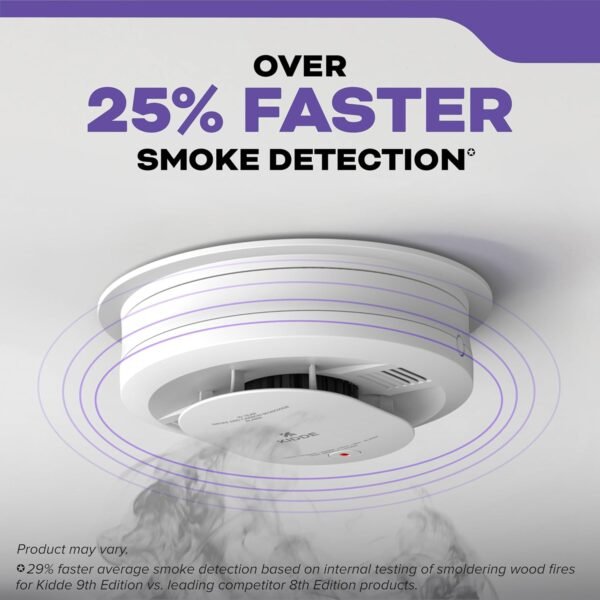
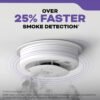
The photoelectric sensor covers smoke and an electrochemical sensor covers carbon monoxide, which is the pairing to look for in a combination unit. Photoelectric sensing responds earlier to smouldering material and is less easily provoked by cooking aerosols than an ionization element, so the two design choices reinforce each other. Kidde specifies that the sensing technology reduces nuisance alarms from steam and cooking fumes, which is a safety feature in its own right, since alarms that trip over dinner are the ones people take down.
An internal self-test runs periodically to confirm the sensors and battery are working. That is a convenience rather than a replacement for the weekly button test the manual asks for, and the two serve different purposes. Households wanting the same Kidde combination sensing with voice announcements instead of tone patterns should look at the hardwired Kidde 900-CUAR with voice warning.
Design and Installation Considerations
The 5-inch circular housing mounts on a ceiling or wall and disappears into a white finish without standing out in a hallway or living room. The twist-and-lock bracket makes the mechanical side quick once the wiring is done, but the hardwired connection itself means isolating the circuit at the breaker and checking every connection before power goes back on. Where alarms are required, and how many, is set by local code and the manufacturer’s instructions rather than by convenience.
The 10-year lithium backup is sealed inside, so there is nothing to replace during service and the whole unit is replaced at end of life. The end-of-life notification beeps clearly and gives ample warning, which is the signal to change the alarm rather than reset it. The rest of our combination smoke and carbon monoxide detector reviews show how that sealed-backup approach now dominates this end of the market.
Value Proposition Compared to Other Smoke & CO Detectors
Weighed against basic alarms, the combination of two sensing functions and the 10-year backup justifies the higher price. It merges two devices into one position and removes the recurring battery cost and the ladder trips that go with it. The interconnect feature is the real separator, since several competing models need an extra module or do not offer it at all. Some rivals add smart home integration; this Kidde stays with the fundamentals, which suits households that would rather not commission an alarm over Wi-Fi.
Product Competitors and How This Alarm Stands Out
Against alternatives such as the Nest Protect or First Alert Onelink, the differences are straightforward. Nest Protect adds smart alerts and phone notifications that this Kidde does not have, at a considerably higher price per unit, which matters when six alarms are being fitted at once. Within Kidde’s own range, the 30CUAR with its voice and false alarm reduction features and the 30CUD10 combination alarm are the closest siblings and the sensible cross-checks before ordering a full set.
The hardwired supply with a long-life sealed backup is what keeps this unit powered through an outage, which is the failure case that catches battery-only alarms with a tired cell. The missing smartphone integration is a genuine gap for anyone who wants to know about an alarm while away from the property. Where only carbon monoxide needs covering at a particular position, the hardwired Kidde KN-COB-IC does that job on its own.
Positive Features That Make It Stand Out
- Two-in-one detection for smoke and carbon monoxide
- 10-year sealed lithium battery backup reduces maintenance
- Interconnecting alarms spread a warning across the whole property
- Enhanced sensing technology cuts down on false alarms from cooking or steam
Areas for Improvement
- Installation could be intimidating for DIY novices due to hardwiring
- The alarm sound might not be sufficient for all sleeping patterns
- LED light notifications need clearer explanations in the manual
- No smart home or mobile app integration for remote alerts
What Owner Ratings Report
Owner ratings for this model return to a few consistent points. The horn is loud, which reviewers note as startling during a test and as the reason it carries through a closed door. The hush button is repeatedly named as the feature that keeps a cooking trip from ending with the alarm disconnected, which is the outcome it exists to prevent.
The interconnected behaviour is the other recurring theme, particularly from buyers with a unit near bedrooms and another in a kitchen or basement, where a detection in one room needs to be heard in another. Nuisance-alarm complaints appear no more often than for competing combination units.
Final Thoughts on Price Worthiness
Paying more for a hardwired detector with a decade-long sealed backup is a reasonable trade for a household that does not want an annual battery routine across several alarms. This model balances cost against features for buyers who want dependable, low-maintenance coverage of two hazards rather than connected devices. Premium units add smart alerts; the argument here is a plain, wired, interconnected setup that works the same way every day. For a smoke and carbon monoxide alarm that runs a decade without battery changes, it fits, provided the wiring is done to code and the weekly test actually happens.