Description
What the System Sensor 2WT-B Specification Covers
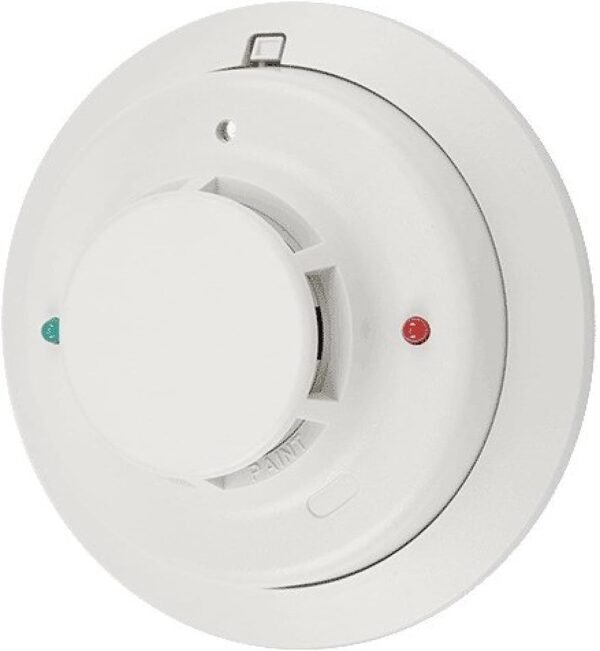
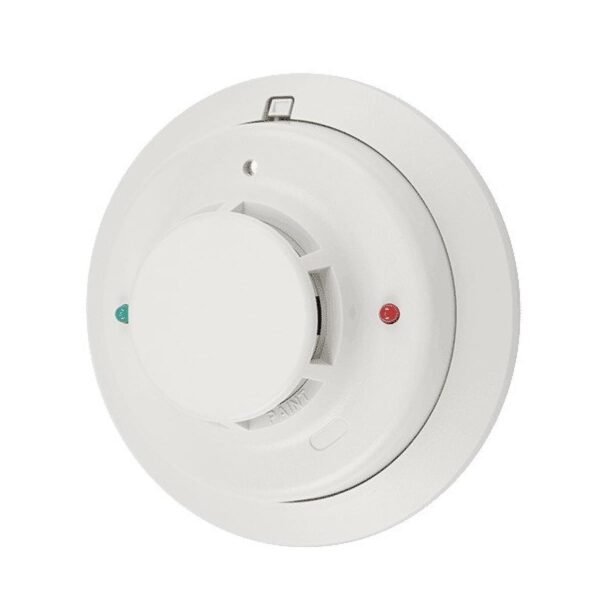
The System Sensor 2WT-B Photoelectric Smoke Detector is a system head rather than a standalone household alarm, and the two sensing elements are its defining spec: a photoelectric smoke chamber paired with a 135 degree fixed-temperature thermal element. The pairing exists because the two elements answer different fire signatures. The smoke chamber responds to the large particles of a smoldering fire, while the thermal element responds only when the air at the ceiling reaches its rated temperature, which is the signature of a fast, hot fire that may outrun the smoke reading in a high or well-ventilated space.
The 2-wire design is the other structural fact. It means the head takes power and returns its alarm signal on the same pair back to a compatible fire alarm control panel, so it drops into an existing conventional circuit without a third conductor. Listed dimensions of 6 x 6 x 3 inches cover the head with its base, and the listed AC/DC power source refers to the panel supply feeding that circuit, not to a wall outlet at the detector.
Photoelectric sensing is also the element that tends to be less reactive to cooking aerosols and steam than an ionization chamber. That is a tendency rather than an exemption, and placement relative to kitchens, bathrooms and supply registers still governs how often a head is tripped by something that is not a fire.
Specification summary:
- Photoelectric smoke chamber plus a 135 degree fixed-temperature element
- 2-wire connection to a compatible fire alarm control panel
- Powered from the panel circuit rather than from a local battery
- Combined smoke and heat sensing in a single head and base
Where the Listing Contradicts Itself
Two figures in the imported listing do not line up and are worth resolving before buying. The first is the 135 degree number. In one place it reads as a temperature rating, which is what a fixed-temperature thermal element in this class normally carries; elsewhere the same figure is described as a coverage angle or field of view, which is not how a thermal element works. The second is power: the listing states that the AC/DC power source keeps the head running through an outage while also noting that there is no built-in battery backup. Both readings cannot be right, and the resolution is at the panel: standby power for a conventional circuit comes from the control panel’s own secondary supply, not from the detector head. Confirm both points against the System Sensor data sheet and the panel documentation.
Points that need checking:
- 135 degrees stated as a temperature rating in one place and an angle in another
- Outage behavior attributed to the head rather than to the panel supply
- No wireless interconnection or smart home reporting of any kind
Installation Context
This is contractor territory. A 2-wire head is one device on a circuit that has to be designed for the panel it serves, and compatibility is not assumed: panels publish lists of detector heads they are listed to work with, and mixing outside that list is not a judgment call to make on site. The base mounts to the box and the head twists into it, which is the part that looks simple, but the design, the wiring, the loop loading and the commissioning are the work.
The retrofit case is a genuine strength here. Buildings with existing 2-wire circuits can take a modern combination head without pulling new cable, which is why heads of this pattern stay in production long after newer addressable systems have arrived. Where a building runs an addressable panel instead, the equivalent device is something like the Notifier FSP-951 addressable photoelectric head, which reports by device address rather than by zone.
Testing follows the same system logic. A head is tested as part of the system on the schedule the governing code and the maintenance contract set, and the results belong in the log for that system. Nothing about the device replaces that schedule or the placement rules that the code applies to detector spacing.
Sensing Behavior in Service
The value of the combined head shows in rooms where either element alone would be a compromise. A smoke chamber in a dusty utility space alarms on dust; a heat element alone in a bedroom waits far too long. Putting both in one head lets a designer place a single device where the fire signature could plausibly be either, and the fixed-temperature element gives a backstop that does not care about particle size at all.
What the head signals is a condition at the ceiling in the room where it is mounted, reported to a panel that decides what happens next. Whether occupants hear anything depends on the notification appliances on that system, because a 2-wire head of this type is a sensor in a chain rather than a self-contained alarm with its own horn.
Maintenance is limited to the cleaning, testing and end-of-life replacement the manufacturer specifies. There is no battery to change at the head, which removes the chirp cycle familiar from residential alarms but does not remove the service interval.
How It Compares
Against a photoelectric-only head, the 2WT-B adds the thermal element for a small price difference, and the plain photoelectric version of the same family, the System Sensor 2W-B, is the direct comparison for anyone deciding whether the heat element earns its place. Against a heat detector on its own, such as the Kidde HD135F 135 degree heat detector, the difference is the smoke chamber, which is what a heat-only device deliberately leaves out for garages, attics and other spaces where smoke sensing would nuisance alarm constantly.
Against connected residential alarms, the comparison is not close, because they solve a different problem. A homeowner who wants phone notifications and per-room voice announcements is shopping in the self-contained category, closer to the hardwired First Alert SMI105-AC with a 10-year backup cell than to anything on a panel circuit.
The broader field, from sealed-battery household alarms to commercial heads and modules, is laid out in the smoke detector and fire alarm category, and the split between self-contained and panel-connected devices is the first thing to settle before comparing on price.
Price and Positioning
Per head, the 2WT-B costs more than a bare photoelectric detector and much more than a retail alarm, and as with any system device the head is a minor part of the installed cost. The case for it is spending a small increment at design time to get two sensing methods on one base instead of specifying two devices or accepting a gap.
For an existing 2-wire building, the retrofit economics are the strongest argument on offer: a combination head on the existing pair costs a fraction of re-cabling to an addressable system, and it keeps a serviceable panel in use for longer.
Practical Considerations
The head has no user interface to speak of beyond the test procedure the system prescribes, and that is intentional in a device meant to be maintained rather than operated. The absence of wireless interconnection means system-wide behavior is defined at the panel, which is where a designer wants it in a commercial building and where a homeowner would find it inconvenient.
Dust is the practical enemy. Photoelectric chambers accumulate it, and a head at the end of its service interval in a dusty environment is more likely to alarm on nothing, which is a maintenance issue rather than a design flaw.
Drawbacks to Keep in Mind
- Not a standalone alarm; it requires a compatible panel and circuit
- No battery in the head, so outage behavior depends on the panel supply
- No wireless interconnect, app reporting or voice announcement
- The listing’s 135 degree figure needs confirming against the data sheet
Read strictly from published specification, the 2WT-B is a conventional 2-wire head that combines photoelectric smoke sensing with a fixed-temperature thermal element for buildings that already have the wiring to support it. It signals a condition to a panel, and the protection an occupant actually gets is set by the system design, the placement rules in the governing code and the maintenance schedule the building keeps.