

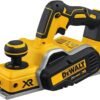
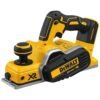


Description
Highlights of the DEWALT 20V MAX Planer
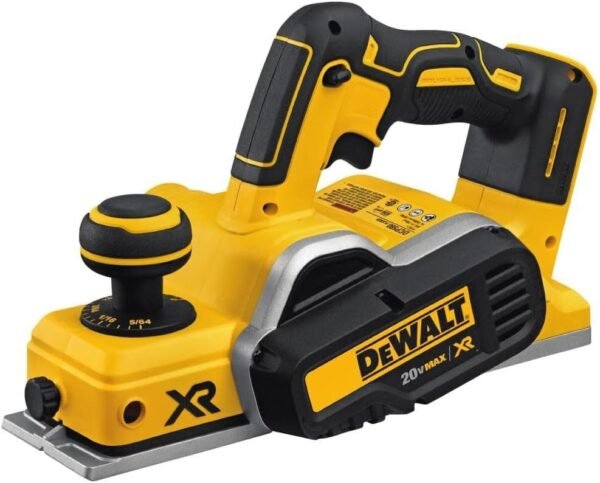
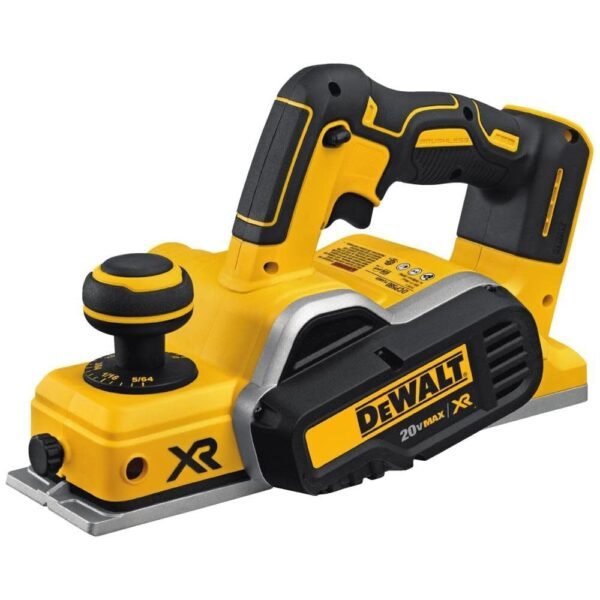
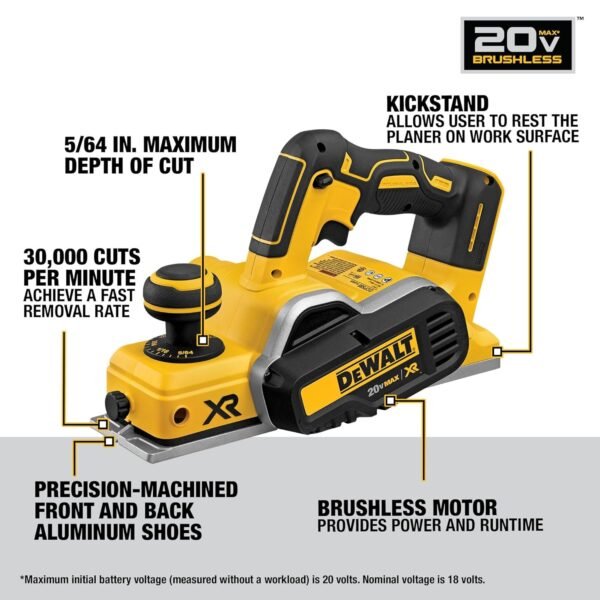
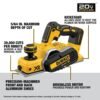
The DEWALT 20V MAX Planer, model DCP580B, is built around several standout features. The brushless motor is the headline specification, rated for power and runtime above what cordless planers of the previous generation delivered, and brushless drives hold speed under load better than brushed ones because less energy is lost to friction at the commutator. The 30,000 cuts per minute figure follows from a two-blade cutterhead spinning at the listed 15,000 RPM. The calibrated depth adjustment knob is specified in increments of 1/256 inch. Listing data is inconsistent here: 1/256 inch converts to roughly 0.1 mm, while the same description states about 0.01 mm, so treat the metric figure as unreliable and the fractional one as the specification. The aluminum shoes are precision-machined to hold the cut parallel through the pass, which is what keeps an edge square without repeated measuring. Comparable models sit in the handheld planers category.
- Brushless motor for superior efficiency
- Precision depth adjustments to 1/256 inch
- High-speed 30,000 cuts per minute
- Durable aluminum base for accuracy
Ergonomics and Ease of Use
Weight is the specification that decides whether a planer stays comfortable through a long session. This model is listed at just 7.4 pounds, and DEWALT pairs that with an ergonomically designed handle intended to reduce hand fatigue over extended runs. The kickstand is the detail that matters between passes: it holds the spinning cutterhead clear of the workpiece when the tool is set down, which is how gouged boards happen on planers without one. Adjustments are conventional, and the depth adjustment knob is detented rather than free-spinning, so a setting can be returned to. The poly-V drive belt is the durability item on the spec sheet, since the belt is the usual wear point on a handheld planer.
Cutting Performance and Precision
The tool is rated for a maximum cut depth of 2 millimeters (5/64 inch), which suits light to moderate smoothing and edge trimming rather than heavy stock removal. The 3-1/4 inch width capacity is the standard handheld figure and covers door trimming and cabinetry work in one pass on most stock. A precision-machined groove in the front shoe adds edge chamfering without an accessory, extending the tool’s range at no extra cost. Across common woods such as pine and oak, cut quality on a planer comes down to blade sharpness and feed rate rather than the motor, and the brushless motor coupled with a 15,000 RPM speed is specified to hold cutterhead speed steady so the blades cut cleanly rather than tearing.
Limitations to Consider
Several drawbacks deserve attention. This is a bare tool only: battery, charger, and dust bag are all sold separately, which raises the real entry price for anyone not already holding DEWALT 20V MAX packs. The dust collection system depends on that separately sold bag and is not a sealed extraction arrangement, so fine dust escapes and a mask or outdoor work remains sensible. The cutting width is the third constraint: 3-1/4 inches is narrow for large surfaces, where a benchtop machine covers the board in one pass instead of several. The planer is also not the lightest in its class, so 7.4 pounds is workable but noticeable next to ultra-light tools.
- Battery and charger sold separately
- Dust collection could be better
- Limited cutting width for large projects
- Slightly heavier than some competitors
Product Alternatives
Against cordless models such as the Makita XPK01Z and the Bosch PL2632, the DEWALT competes on brushless motor efficiency and precision depth control. Makita’s equivalent publishes a slightly wider cut width without the micro-adjustment DEWALT specifies in 1/256 inch increments. Bosch offers better dust collection and lower weight, which favours clean workspaces and portability. On runtime and power consistency under load, the DEWALT specification holds the advantage. A corded alternative such as the Makita KP312 15 amp corded planer removes the battery question entirely and covers far wider stock.
Competitors vary in price and bundled accessories, and many ship with batteries and chargers, which is the better arithmetic for anyone starting fresh. For an existing DEWALT 20V MAX owner, this unit joins the platform without additional cells. It suits professionals and committed hobbyists who need reliable power and precision without a cord. Anyone whose work runs to dimensioning boards rather than trimming them should be comparing the DEWALT DW734 benchtop planer instead, since the two tools solve different problems.
Value Assessment
Weighed against the features packed into this planer, the price point tracks what it offers. Brushless motor technology, accurate depth adjustments, and a rugged aluminum base are the three specifications that justify the spend for anyone who values performance and durability. The extra purchases for battery and dust bag add to the upfront cost, but the tool does not trade power away for cordless convenience. For an owner already on the DEWALT 20V MAX battery system, the value case is stronger still.
This is not a budget tool, and it does not read as overpriced either. The combination of cutting speed, precision, and ergonomic design supports the investment where woodworking or renovation is a regular activity rather than an occasional one. On the published specification it offers solid bang for the buck given the materials, engineering, and included adjustments.
Versatility Across Woodworking Tasks
The specification covers a spread of tasks, from smoothing rough lumber to chamfering edges. The precision-machined groove for chamfering is the feature most likely to be underused at purchase and relied on later, since it removes a separate setup for a common operation. Fine depth increments mean a finish pass can be dialed in rather than estimated, which is where the calibrated knob earns its place. Cordless operation is the other structural advantage: no cord to trip over and no extension lead across a shop floor. A quieter, quicker option for detail work is a multi-tool such as the DEWALT DCS356C1 XR oscillating tool kit, which runs on the same 20V MAX packs.
The separate battery and dust bag purchases remain the main friction point, and they are worth planning for before a first cordless tool rather than after. The brushless motor also runs cooler and quieter than older brushed designs, which matters across a long session. Overall the tool is specified as a dependable option for detailed woodworking and general carpentry.
Downsides Worth Mentioning
Several pitfalls are worth naming. The depth adjustment knob’s fine increments are an asset and a demand at once: fine steps take patience to set, and a hurried adjustment overshoots into an over-deep cut. The dust bag attachment does not seal completely, so fine dust escapes during the pass. That is not disqualifying, but it does mean extra cleanup and protective gear.
The weight is the second caveat, most relevant when the tool is held overhead or worked on a vertical surface for a long stretch. The absent battery and charger are the third, since the total cost climbs quickly for anyone not already invested in the DEWALT ecosystem. A benchtop machine such as the Makita 2012NB portable planer avoids both issues by staying on the bench and plugging into the wall.
- Depth adjustment requires careful handling
- Dust bag does not fully contain fine dust
- Weight can be tiring in awkward positions
- Additional purchases needed for full operation
On the published specification this planer is a powerful, precise tool that fits serious woodworking workflows, provided the extras around it, power source and dust management, are planned for at the point of purchase.