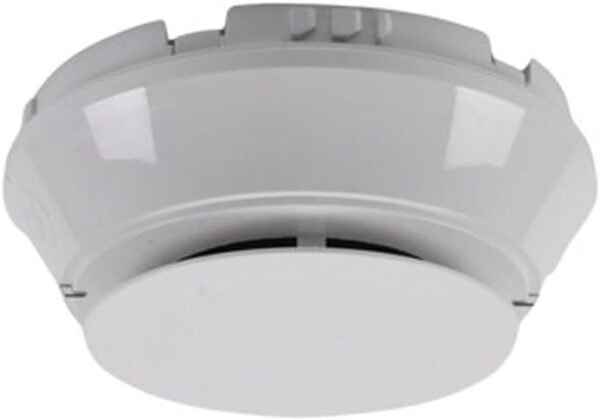
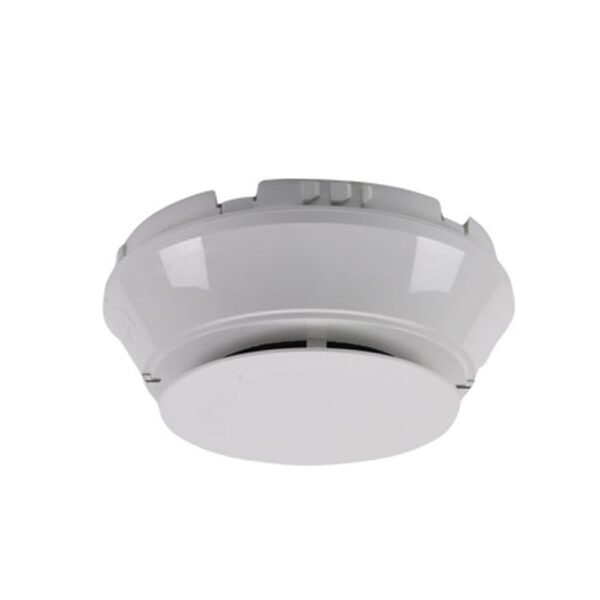
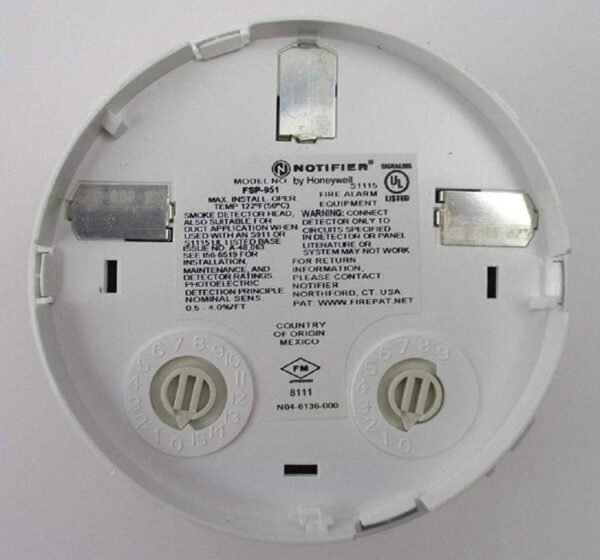




Description
What the FSP-951 Specification Offers
The Notifier FSP-951 is a commercial detector head, not a retail smoke alarm, and the specification reads that way. Its intelligent addressable photoelectric sensor reports a value to a fire alarm control panel rather than simply sounding, which is what allows a panel to apply its own thresholds, verification timing and drift compensation to the raw sensor reading.
FlashScan is the Notifier polling protocol the head speaks, and it exists to shorten the time a panel needs to interrogate every device on a loop, so a change in state is reported to the panel and to the annunciator faster than sequential polling allows. The listed visual alarm indication gives an alternative to sound in areas where an audible signal alone is not sufficient. Devices in this family are components of an engineered system, and selection, loop loading, addressing and commissioning belong to the fire alarm contractor and the authority having jurisdiction, not to a product listing.
- Addressable photoelectric sensing reported to the panel by device address
- FlashScan polling for faster panel communication
- Visual alarm indication as an alternative signaling method
Limitations to Consider
The power description in the listing is the first thing to check. It gives the power source as plug-in and separately notes that no batteries are included, which conflates two different things: a detector head of this type plugs into a mounting base and draws its power from the panel signaling line circuit, so it has no battery and no wall plug at all. Confirm the base, the loop and the panel compatibility against the Notifier data sheet before ordering, because a head bought without the matching base is not an installable device.
The listed upper temperature rating of 57 degrees Celsius rules out unconditioned attics, boiler rooms and commercial kitchen ceilings, which are exactly the spaces where a heat detector or a combination unit is specified instead. The listed size of 5″ diameter and 2″ height is normal for a commercial head but larger than the flat residential alarms buyers may be picturing, and the plain white housing is chosen for uniformity across a building rather than for appearance in a living room. Anyone shopping for a home is in a different part of the smoke detector and fire alarm range entirely.
- No battery backup in the head; power comes from the panel loop
- Upper temperature limit restricts hot and unconditioned spaces
- Requires a compatible base and an addressable Notifier panel
Design and Build
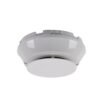
The white housing is the standard commercial finish, unobtrusive against a ceiling grid in an office or a corridor. The published weight of 0.29 pounds is trivial for the base to carry, which keeps the mechanical side of the install simple once the base is properly fixed and wired.
Inside, the photoelectric chamber is the sensing element, reading light scattered by smoke particles in the chamber. Photoelectric sensing responds well to the large particles produced by smoldering fires, which is the typical fire signature in offices, storage areas and sleeping rooms. The visual indicator supplements the audible notification appliances elsewhere on the system, and in an addressable installation the head also identifies itself by address so the panel can report the exact location rather than a zone.
Installation Context
Installation is not a homeowner task. The head is one device on a signaling line circuit that has to be designed, loaded, addressed, wired and commissioned as a system, and the work is done by a licensed fire alarm contractor under the governing code and the local authority. What the product listing calls a simple style refers to the mechanical fit of head to base, not to the project around it.
Once the system exists, service is routine: heads are tested, cleaned and eventually replaced on the schedule the code and the manufacturer set. Detector heads in the same family cover different sensing needs, and the System Sensor 2WT-B with its combined photoelectric and thermal element shows the alternative arrangement where a fixed-temperature element is wanted alongside smoke sensing.
Behavior in Service
Photoelectric heads are specified partly because they are less reactive to the fine particles from cooking and from steam than ionization chambers, which reduces avoidable alarms in occupied buildings. That is a tendency, not an exemption: dust loading, aerosols and construction work still cause alarms, which is why an addressable panel can apply verification delays and why drift compensation exists.
The addressable design also changes what happens after an alarm. Instead of a zone light, the panel names the device, so responders go to a location rather than a floor. Conventional two-wire heads such as the System Sensor 2W-B photoelectric detector sit at the other end of that trade-off, cheaper per point and simpler to wire, but reporting only by zone.
Alternatives and Positioning
Comparisons with retail brands are mostly a category error. First Alert and Kidde build self-contained residential alarms with their own horn and their own power source; the FSP-951 has neither and cannot work outside a panel. Where they overlap is the sensing chamber, and a homeowner wanting photoelectric sensing is better served by a self-contained unit such as the Kidde P3010B photoelectric alarm with a 10-year sealed battery.
Within the commercial world, the meaningful comparisons are other addressable heads on other panel protocols, and the choice is usually made by the panel already installed. A building running Notifier hardware buys Notifier heads; a mixed estate ends up standardizing for the same reason. Peripheral loop devices matter too, and the Notifier FMM-1 monitor module is the piece that brings conventional contacts and devices onto the same addressable loop.
Price in Context
Per device, an addressable photoelectric head costs more than a conventional one and far more than a residential alarm, and the price only makes sense as part of the system total: panel, loop, bases, modules, programming and commissioning. Measured that way, the head is a small line item and the labor is not.
The saving that justifies the addressable premium is operational: fewer false evacuations from panel-side verification, faster location of a device in alarm, and easier service because the panel reports which head is drifting.
Specification Strengths
- Addressable photoelectric sensing with device-level reporting
- FlashScan protocol for faster panel polling
- Visual alarm indication alongside system notification appliances
- Light 0.29 pound head that plugs into a standard base
Areas Buyers Should Check
- Panel and base compatibility, since the head is not a standalone device
- Ambient temperature against the 57 degree Celsius upper limit
- The conflicting power description in the listing
- Whether the application actually calls for smoke rather than heat sensing