
Description
What the NOTIFIER FMM-1 Monitor Module Does
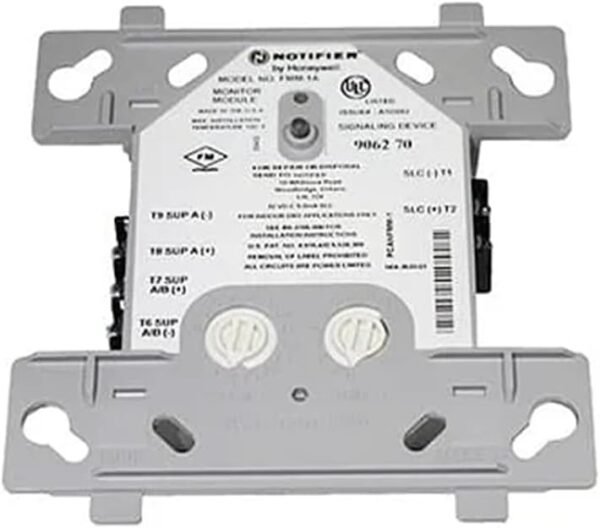
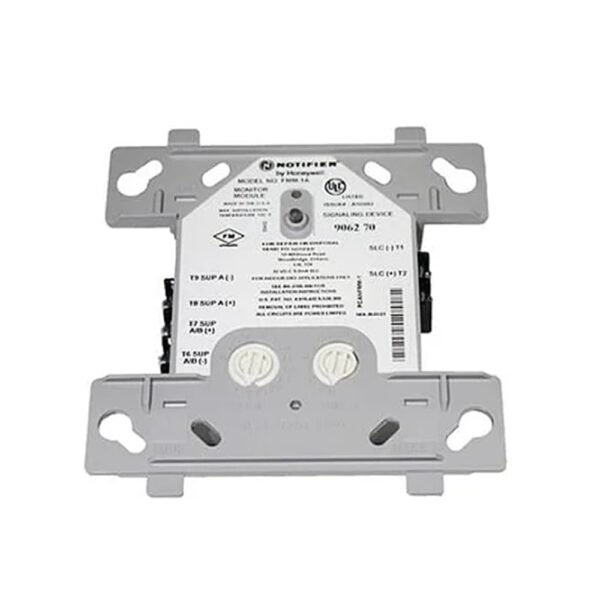
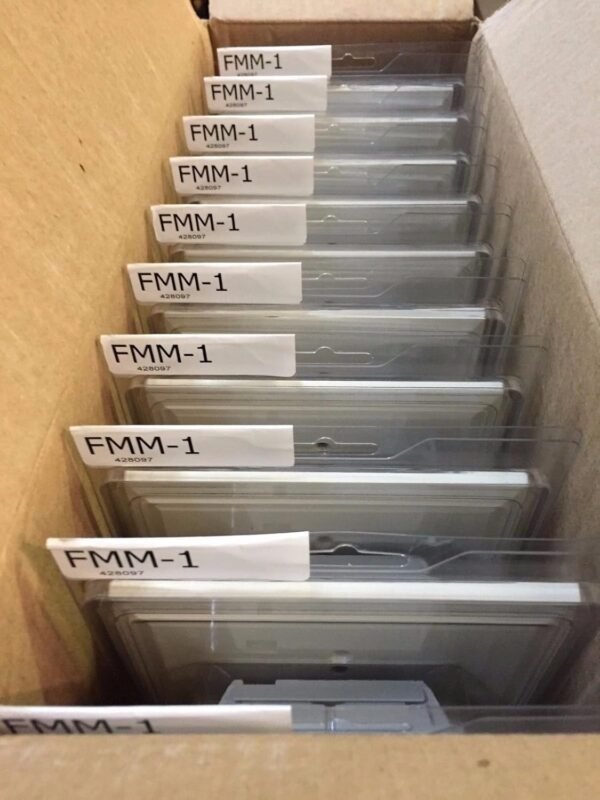
The NOTIFIER FMM-1 Monitor Module is an interface device, not a detector and not an alarm. Its job in an addressable fire alarm system is to put a contact-closure device onto the addressable loop and give it an address, so that a waterflow switch, a valve tamper switch, a conventional pull station or a conventional initiating circuit reports to the panel as an identified point rather than as an anonymous zone. That is the whole value proposition: the panel names what changed state instead of pointing at a floor. The module is FlashScan compatible, which is the NOTIFIER polling protocol that shortens the time a panel needs to interrogate every device on the loop, and the listed ivory housing is the standard finish for a device that usually lives inside a backbox or an equipment enclosure.
- FlashScan polling for faster panel communication
- Brings conventional contact devices onto an addressable loop
- Reports by device address rather than by zone
- Light 5.6 ounce module in a standard ivory finish
Where the Listing Contradicts Itself
The imported specification cannot be taken at face value on power. One line describes a battery-powered design, another states that no batteries are included, and a third says the module has no internal battery and depends on an external supply. A loop device of this type is powered from the panel’s signaling line circuit, which is also where its standby power comes from during a mains outage, so the battery language appears to be listing noise rather than a specification. The same listing attributes an audible alarm to the module, which sits oddly with an input device whose output is a report to the panel; notification in these systems is produced by the notification appliances the panel drives. Confirm both points against the NOTIFIER data sheet for the FMM-1 before specifying it, because the power arrangement determines loop loading and the audible question determines whether a separate appliance is required.
- Battery language conflicts with the no-battery and external-supply statements
- An audible output is listed for what is otherwise an input device
- No visual status indicator described on the module itself
- Package dimensions are bulky relative to crowded enclosures
Design and Build
The module is a small plastic-bodied device built to sit in an enclosure for the life of the system, so the construction priorities are secure terminations and dimensional stability rather than appearance. The ivory finish is practical for that setting, blending into panels and backboxes without drawing attention. At 5.6 ounces it adds nothing meaningful to a backbox, and the design puts function ahead of styling in a way that suits a component nobody looks at again after commissioning. Secure connectors matter more than any of that, because a loose termination on a monitor module produces a trouble condition on the panel and a service call to find it.
Installation Context
This is not a homeowner product and it is not a plug-in accessory. The FMM-1 is one point on a signaling line circuit that has to be designed, addressed, loaded and commissioned by a licensed fire alarm contractor working to the governing code and the local authority having jurisdiction. Addressing is done at install time, the loop has a device limit, and the panel program has to be updated to know what the new point represents. What the listing calls straightforward is the mechanical part: the module itself is small, light and quick to terminate once the design work is done. Detector heads on the same loop, such as the NOTIFIER FSP-951 addressable photoelectric head, are commissioned through the same process.
Function in the System
In service, the module’s contribution is diagnostic clarity. A monitored waterflow switch that reports as a named point tells a panel operator which riser tripped; the same switch on a conventional zone tells them only that something on that zone did. On a large site that difference is the gap between checking one location and walking a floor. Because the module is polled continuously, an open or shorted input also reports as a trouble rather than sitting silent until the next inspection, which is the failure mode that matters most in a device whose whole purpose is supervision.
Interface devices exist in conventional systems too, in a much simpler form. The Kidde SM120X relay module is the residential and light commercial equivalent of the idea, translating an alarm condition into a contact closure for something else to act on.
Value in Context
Per point, an addressable monitor module costs more than the conventional wiring it replaces, and the arithmetic only works at the system level. The saving is in the panel program and in service time: identified points reduce the time to locate a fault, and they reduce the number of devices that have to be tested blind. For an owner with a maintenance contract, that shows up as recurring labor rather than as a line on the purchase order. Buyers looking at the broader range of devices these systems are built from can browse the smoke detector and fire alarm category, though the panel already installed usually settles the brand question before price enters it.
Alternatives and Compatibility
Comparable modules from Honeywell and Siemens exist, and some publish onboard LED indication that the FMM-1 listing does not describe, which is a genuine convenience during troubleshooting. In practice the comparison rarely gets that far, because a monitor module has to speak the protocol of the panel it is wired to, and a building running NOTIFIER hardware buys NOTIFIER modules for the same reason it buys NOTIFIER heads. Where a design needs sensing rather than an interface, the device on the other end of that decision is a detector such as the System Sensor 2WT-B photoelectric and thermal head, or a heat-only unit like the Kidde HD135F 135 degree heat detector where smoke sensing is unsuitable.
Support and Documentation
Documentation availability is worth as much as the hardware with devices of this kind, because the compatibility list, the loop loading figures and the addressing procedure all live in the data sheet and the panel manual rather than in the retail listing. Buyers should expect to work from those documents and from the fire alarm contractor’s design, and to treat the marketplace specification as an ordering reference only.
Taken as a specification, the FMM-1 is a small addressable interface that earns its place by turning conventional contacts into identified points on a NOTIFIER loop. It signals a change of state to a panel; everything an occupant experiences after that is a function of the system design, not of the module.