Description
Highlights of the Milwaukee M12 FUEL Brushless Ratchet
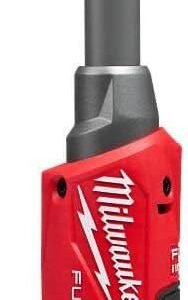
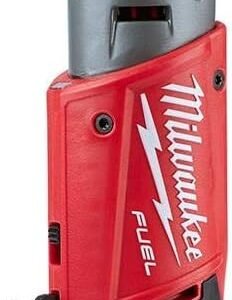
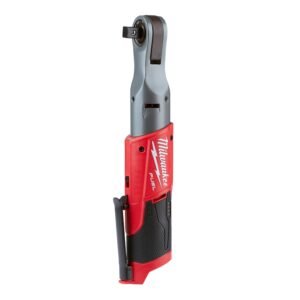
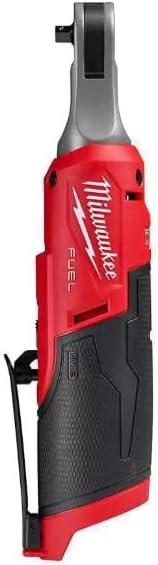
The Milwaukee 2566-20 M12 FUEL Brushless Lithium-Ion 1/4 in. Cordless High Speed Ratchet is specified around compact size and low weight. At just under two pounds it sits well below most cordless ratchets, and that figure is the single best predictor of how the tool behaves through a long session. The powder-coated finish is a wear coating rather than paint, chosen for a tool that gets dragged across brackets and dropped into trays. The 1/4 inch drive is the other defining choice: smaller sockets, smaller fasteners, faster work.
The brushless motor is what supports both the speed rating and the longevity claim, since there are no brushes to wear or to lose efficiency as they do. A maximum rotational speed of 450 RPM is high for this class, and it is aimed squarely at running threads down quickly rather than at breaking fasteners loose. Note what the listing does not publish: there is no maximum torque figure anywhere in the specification, which is a meaningful omission on a tool sold partly on power. The M12 FUEL battery platform supplies the rest of the package.
Drawbacks to Keep in Mind
This is a tool only listing, so battery and charger are separate purchases. For an existing M12 owner that is the cheapest way to buy; for a newcomer it is an incomplete tool at checkout, and the M12 FUEL 2567-22 kit with batteries and charger included is the fairer price comparison against rival bundles.
The fixed square head holds sockets securely but offers no articulation, so approach angles are fixed by wherever the body can be placed. In a crowded engine bay that is the constraint that decides whether the tool fits at all. Run time tracks battery capacity directly, so a compact 2.0Ah pack will need swapping more often than the specification alone suggests on sustained work.
Compact Design and Build Quality
Listed dimensions of 3 x 11 x 2 inches put this among the smaller powered ratchets available, and the slim profile is what allows it into gaps a full size tool cannot enter. Alloy steel construction carries the mechanical load without pushing the weight up, which is the balance every ratchet design is trying to strike. The powder-coated finish is the outer layer of that same durability argument.
The grip area is shaped for control with oily or wet hands, which is the realistic condition of use. Low weight matters most to anyone working with the tool raised or extended for long periods, since wrist fatigue on a ratchet comes from holding position rather than from applied force.
Versatility and Performance in Everyday Use
The tool is built for quick tightening and loosening of smaller fasteners: automotive interior work, brackets, metal furniture, and anything where the fastener count is high and the torque demand is moderate. The brushless motor holds output steady across the charge, and 450 RPM is what makes repetitive work fast.
Against that, the source describes the tool as having no variable speed control, meaning output is close to all or nothing. That is limiting on delicate fasteners, where feathering the trigger is normally how overtightening is avoided. Anyone whose work needs that control, or needs more pulling power, should compare the 55 ft-lbs M12 FUEL 3/8″ ratchet, which is geared the other way. The quick-change 1/4 inch drive keeps socket swaps fast, and cordless operation removes the hose and cable entirely.
Price Worthiness Compared to Other Tools
For users already on the M12 platform, the value case is strong: the bare tool price buys a brushless motor, a genuinely small body, and a high speed rating. It is not the cheapest cordless ratchet available, and it is not trying to be.
Bought standalone with battery and charger, the total climbs and rival bundles become competitive. The counterweight is service life, since alloy steel and a powder-coated finish hold up better than the painted zinc found on budget tools that chip and corrode. The full field is collected in our cordless ratchet wrench reviews.
Product Comparisons
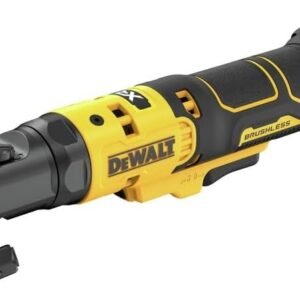
Competing cordless ratchets from DEWALT and Makita reach similar or higher torque while generally carrying more weight. The DEWALT ATOMIC DCF512B ratchet is representative: more output on a 20V platform, in a heavier body that is felt in extended overhead use. Makita’s cordless ratchets compete on runtime from larger 18V packs.
What separates this Milwaukee is the combination of brushless efficiency and 450 RPM in a sub two pound tool. Its clearest weakness against rivals is the empty box. Within Milwaukee’s own 1/4″ drive range, the M12 2456-20 quarter inch ratchet is the slower and cheaper option on the same battery system, and worth pricing before paying for the FUEL speed rating.
Positive Features That Matter
- Light and compact, suited to tight spaces and long sessions
- Brushless motor for tool life and efficient power delivery
- 450 RPM top speed for fast tightening and loosening
- Durable powder-coated finish over alloy steel
- Runs on Milwaukee M12 FUEL Lithium-Ion batteries
Areas of Concern to Consider
- Sold as tool only, requiring separate purchase of battery and charger
- Fixed square head limits approach angles in awkward positions
- No variable speed control, which is restrictive for delicate work
- Run time depends on battery capacity; frequent swaps on long jobs
Read as a whole, the Milwaukee M12 FUEL 1/4 in. Cordless High Speed Ratchet is a specialist rather than a general purpose tool. Its speed, size, and build are the reasons to buy it, while the missing battery, the fixed head, and the unpublished torque rating are the reasons to check your own work first. For high volume small fastener work, it is well matched. For seized bolts, it is the wrong tool in the range.