Description
Highlights of the First Alert CO710 Carbon Monoxide Detector
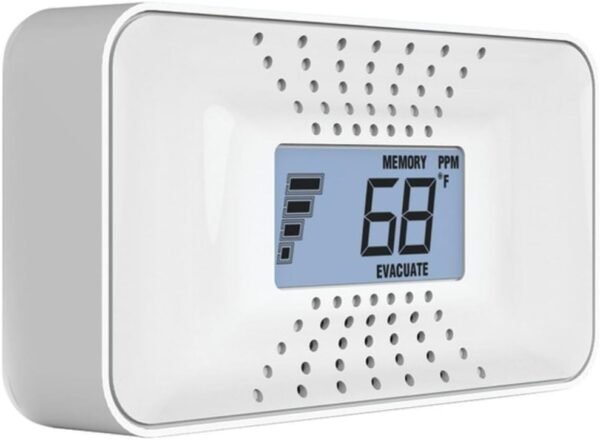
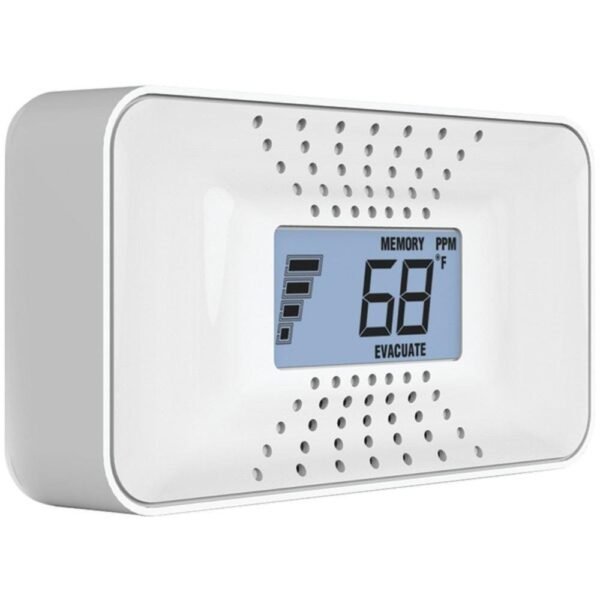
The First Alert CO710 Carbon Monoxide Detector with 10-Year Battery and Digital Temperature Display is specified around a sealed 10-year lithium battery, so the published service plan is a decade of operation with no cell changes and a whole unit replacement at the end of that window. Detection is handled by an electrochemical sensor, the sensor class the listing names for carbon monoxide, a gas that is invisible, odorless and tasteless. The backlit digital display reports ambient temperature alongside a real time CO reading in parts per million, which is more information than the single status light carried by most alarms in the carbon monoxide detector category. The peak level memory stores the highest concentration the sensor has recorded since the last reset, so an exposure figure can be read after the event rather than only while the horn is sounding.
- Battery operation means monitoring continues when household power drops.
- Published alarm output of 85 decibels.
- Digital temperature readout in addition to the CO figure.
Downsides to Consider
Several published limits are worth weighing. The form factor is a tabletop or shelf unit rather than a wall or ceiling mount, so placement follows flat surfaces instead of the mounting points a whole home layout normally assumes. The alarm signal is the standard CO tone pattern, which sound alone will not separate from other household alarms; the display is what identifies the cause. The backlit screen lights during an alarm and on demand, a point worth considering for a bedside table. Price also sits above plainer alarms such as the battery powered First Alert CO400, which drops the screen and the peak memory entirely.
- Not designed for wall mounting.
- Backlit display is visible in a dark room when active.
- Tone alone does not distinguish this alarm from other devices.
Easy-to-Use Features and Daily Functionality
The control set is deliberately small. A single test and silence button runs the self test and temporarily quiets a triggered alarm, which is the standard arrangement on sealed battery CO units. The battery only design keeps the unit independent of house wiring, so it can be moved between rooms without an electrician, unlike a hardwired unit such as the Kidde KN-COB-IC with 9 volt backup. One piece of listing wording is worth clearing up: continuous operation during a power outage is presented as a feature, but since there is no mains connection at all, outage operation here is simply normal operation rather than a backup mode. The end of life chirp signals when the sealed cell and sensor have reached the end of the rated 10 year term and the whole unit needs replacing.
Design and Build Quality
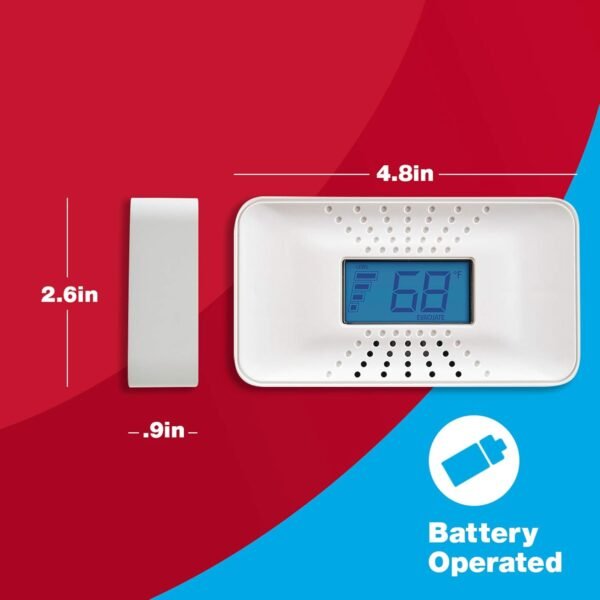
Published dimensions are 0.9 inches deep by 4.8 inches wide by 2.6 inches high at a weight of 0.4 pounds, which places the CO710 among the smaller free standing CO alarms. The white housing is plain, and the base is broad enough relative to the height to sit stable on a shelf. The backlit digital display is legible from across a room and shows a numeric ppm value and a temperature rather than icons. There is no wireless radio, app or smart home integration in this model, so remote notification is not part of the specification at any price.
Comparing to Popular Competitors
Within battery powered CO alarms the CO710 competes on display and battery term rather than connectivity. Units with Wi-Fi or hub integration add remote alerts that this model does not offer. Against the Kidde C3010 sealed battery alarm the specification difference is the numeric readout and the peak memory, since both run a sealed 10 year cell. Electrochemical sensing is the sensor class used across mainstream residential CO alarms and is the type published for this unit. Voice alerts and multi gas sensing are absent here, so a buyer who wants spoken cues should be looking at combination units instead.
Price to Quality Ratio
Judged on published specification per dollar, the CO710 asks a premium over plain horn and light alarms and returns a screen, a peak reading and a sealed decade cell. Whether that is worth the difference depends on how much the ppm figure is worth to a given household. A plug-in unit such as the First Alert CO605 with battery backup takes a different route, drawing from an outlet with a replaceable cell as fallback. The argument for the CO710 is simplicity: nothing to wire, nothing to plug in and no scheduled battery purchase across the rated life.
Alarm Output, Display and What the Unit Signals
The published 85 decibel horn is the residential norm for CO alarms. What the device signals is a measured CO concentration crossing the published alarm thresholds; it does not sense smoke, natural gas or any other hazard, and it does not replace the alarm coverage a local building code sets out or the judgment of a qualified installer. The temperature readout is an ambient figure and carries no safety function. The peak level memory is the feature most likely to matter after an event, since it retains the highest recorded reading for review by a technician or a utility responder.
Installation and Portability
No wiring and no tools are required. The unit sits on a flat surface, runs from the sealed cell and stays powered, which suits renters and anyone who cannot drill into a ceiling. The trade off is that it cannot be fixed at the height a code compliant layout may call for, so it fits best as an addition to permanently mounted alarms rather than as the only CO device in a dwelling. Manufacturer placement guidance and local code should decide where CO coverage sits, because a portable unit is as easy to move to the wrong place as the right one.
Overall the First Alert CO710 is a specification led choice: electrochemical sensing, a sealed 10 year cell, a numeric display with peak memory and an 85 decibel horn, with no connectivity and no wall mounting. That combination reads best for a bedroom table, a hallway shelf or an office desk where a readable number is more useful than a phone notification.