





Description
Positive Features of the Kidde KN-COEG-3 Carbon Monoxide and Explosive Gas Alarm
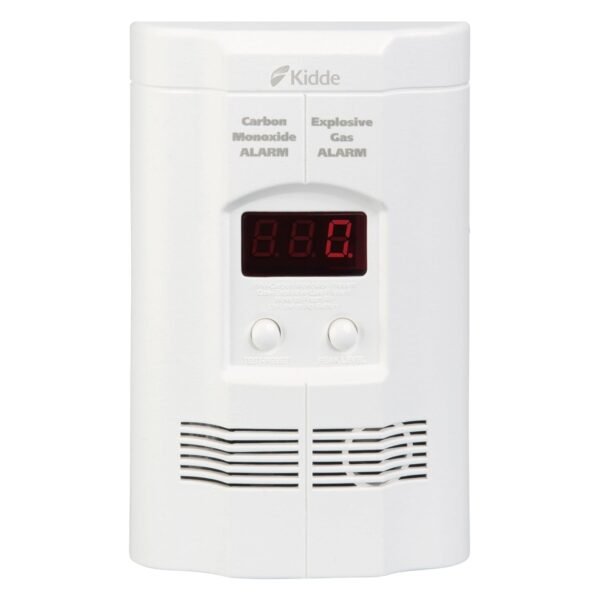
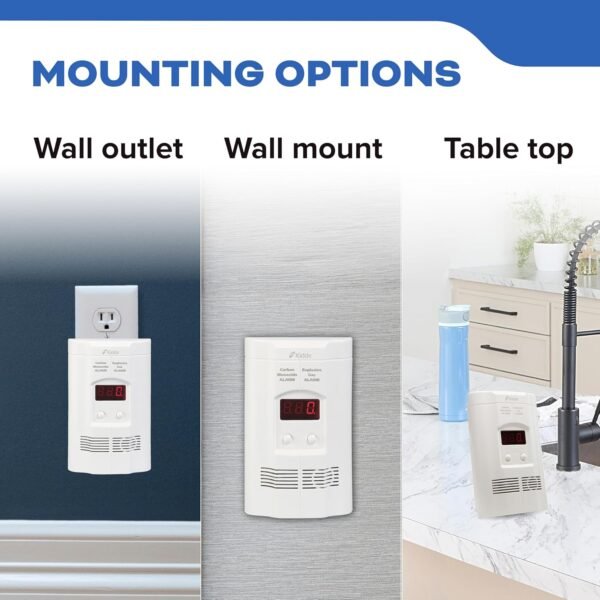
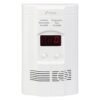
The Kidde KN-COEG-3 covers two hazards that usually need two devices. Its plug-in wall design takes any standard 120V outlet, so there is no wiring and no ceiling work. The 9-volt battery backup carries the alarm through a power cut, which matters because a furnace problem and a blackout can arrive together. The digital LED display is the feature that separates this unit from a plain sounder: it shows the current carbon monoxide level in parts per million, and flashes “GAS” when it senses propane, methane or natural gas. A running figure gives context that a beep on its own cannot, which is the same argument for a display on a CO only alarm.
The peak level memory is the other genuinely useful function. It stores the highest CO reading recorded since the last reset or unplug, which turns an intermittent problem into something a heating engineer can act on rather than a story about a beep last Tuesday. The Smart-Hush button silences a nuisance alarm from cooking or steam for a set period without disabling the unit, which is the behavior that keeps an alarm on the wall rather than in a drawer.
- Easy plug-in installation with 120V AC power
- 9V battery backup for outages
- Digital display updates CO and gas levels every 15 seconds
- Peak level memory for tracking recent dangerous readings
Areas for Improvement in the Kidde Alarm
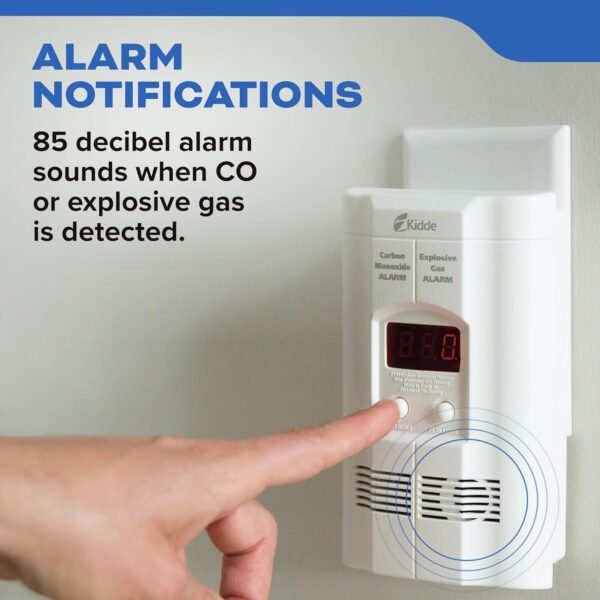
The design has clear constraints. The 85-decibel alarm is the standard residential output, and owner ratings frequently mention nuisance activations where a unit sits close to a kitchen or bathroom. Kidde’s instructions call for the alarm to be at least 15 feet from cooking appliances, which limits which outlets are usable and is a requirement rather than a suggestion. Where a home lacks an outlet in the right place, that constraint decides the purchase, not the feature list.
The 6-foot extension cord extends the reach a little but not far. A longer cord, or a battery only version, would suit more layouts. The digital display is informative up close and harder to read across a room or in low light. The housing is bulkier than the slim CO only alarms now common, which shows on a wall outlet in a living space.
- Nuisance alarms are more likely near kitchens or bathrooms
- Limited extension cord length restricts flexible placement
- Display visibility reduced in low light conditions
- Design bulkier than some competing models
Comprehensive Feature Overview
This is not a CO detector with a bonus function. It is a multi-gas device covering carbon monoxide, methane, propane, natural gas and sewer gas, using two separate sensing technologies: an electrochemical sensor for carbon monoxide and a metal oxide sensor for explosive gases. What it does not do is detect smoke, so it is an addition to smoke detection rather than a replacement for it, and households comparing coverage usually read it alongside the Kidde KN-COSM-BA smoke and CO alarm.
The rotatable plug keeps the body upright on a horizontal or vertical outlet, which keeps the display readable rather than sideways. The test/reset button checks the horn and the circuitry. Published environmental limits give an operating humidity range of 5% to 95% and a temperature ceiling of 100°F, which covers normal living space and rules out an unheated garage in most climates.
Price Worthiness of the Gas and Carbon Monoxide Detector
The value case rests on dual function. Single purpose CO alarms cost less, but a home with gas appliances that wants explosive gas coverage as well would otherwise buy two devices and use two outlets. The five-year limited warranty is shorter than the ten year warranties on sealed battery alarms, and worth reading against the replacement interval Kidde states for this model.
Against premium units with app alerts, this one has none of that and answers with a display, a peak memory and a backup cell. For households that want a readable local alarm rather than a connected one, that is a reasonable trade. A buyer who wants only carbon monoxide coverage with a decade of runtime is looking at a different device, closer to the sealed battery Kidde C3010.
Disadvantages of the Kidde KN-COEG-3
The largest gap is the lack of any remote monitoring. There are no phone notifications and no alerts when nobody is home, which is exactly the window in which a slow CO buildup or a small gas leak develops unnoticed. On a large property, an alarm sounding in a hallway nobody is standing in has done all it can.
The digital display also stops at the peak reading. There is no logging and no history to hand to a professional, which limits its usefulness for diagnosing an intermittent fault over weeks. Owner ratings mention sensitivity to humidity and steam producing nuisance alarms even where Kidde’s placement guidance has been followed.
- No wireless connectivity or app alerts
- Limited data logging beyond peak CO levels
- Can be prone to nuisance alarms from humidity or steam
- Bulkier design may not suit minimalist setups
Product Competitors and How This Alarm Stacks Up
Against the First Alert plug-in carbon monoxide alarms and Nest Protect, the KN-COEG-3’s advantage is the plug-in with battery backup arrangement, which keeps working when a plug-in only unit goes dead in an outage. Nest Protect answers with smartphone connectivity and spoken alerts, at a higher price and with a dependency on the home network.
First Alert uses comparable electrochemical sensing for carbon monoxide but does not add explosive gas detection in the same unit, which is the reason to choose the Kidde in a house running propane or natural gas appliances. Households that would rather wire an alarm in than give up an outlet have the hardwired Kidde 30CUAR as the nearest alternative.
Installation and Usability
Setup is a plug and a battery: the unit goes into an outlet and the included 9V cell into the compartment. The installation guide is short because there is little to get wrong beyond position, and position is the part governed by Kidde’s instructions and local code rather than by which outlet is free. Pressing the test button confirms the horn.
The Smart-Hush feature is the one owners with young children single out, since it quiets a cooking related activation for about eight minutes instead of leaving people to unplug the alarm. That distinction matters: an unplugged alarm is not monitoring anything, and the unit needs to stay in the outlet to do its job. A handheld sniffer such as the Klein Tools ET120 is the tool for tracing a leak once an alarm has sounded, not a substitute for the fixed alarm.
Safety Features and Alarm Patterns
The audible alarm pattern distinguishes the two hazards, which matters because the correct response differs. Kidde specifies four short beeps every five seconds for carbon monoxide, and a beep every other second with “GAS” on the display for methane or propane. Learning which is which before an alarm sounds at night is worth the two minutes it takes.
The listing states the unit meets UL 2034 and UL 217, along with approvals from fire safety authorities and HUD. Those two standards do not obviously belong together here: UL 2034 covers residential carbon monoxide alarms, while UL 217 covers smoke alarms, and this unit has no smoke sensor. Treat the standards list as needing confirmation against Kidde’s own documentation before relying on it. The listing is similarly loose on backup power, crediting the 9V cell with continuous monitoring in one place and warning that the alarm needs continuous mains power in another, so check Kidde’s stated backup runtime rather than assuming either version.
The KN-COEG-3 is a plug-in alarm covering carbon monoxide and explosive gases with a readable display, a peak memory and a 9V backup. It suits households with gas appliances that want a local alarm rather than a connected one, and it sits alongside smoke detection rather than replacing it, a split covered across our combination gas and carbon monoxide detector reviews.