





Description
Highlights of the Kidde Hardwired Smoke Detector
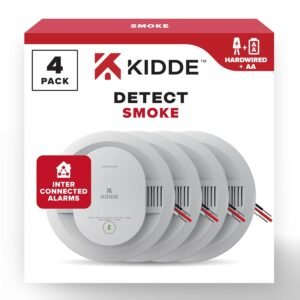
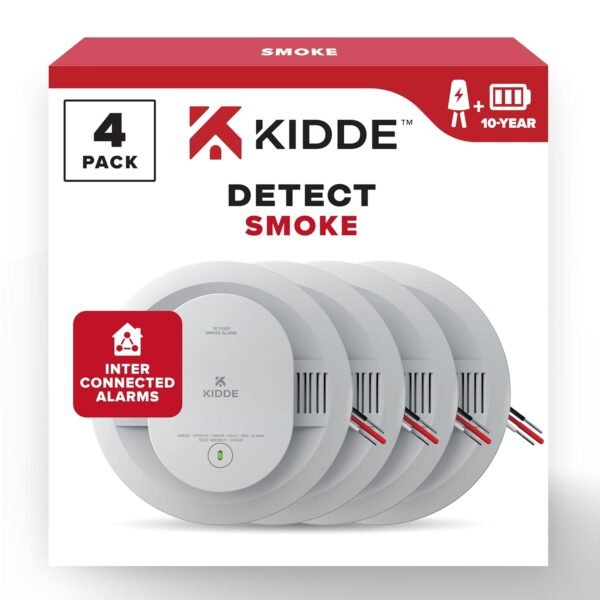
The Kidde Hardwired Smoke Detector, 10-Year Battery Backup, Interconnectable, LED Warning Light Indicators, 4 Pack is sold as a whole-floor kit rather than a single alarm, and the specification reads that way. Its enhanced sensing technology is Kidde’s term for the logic that holds down nuisance alarms from cooking, the trigger that leads people to disable an alarm and leave it disabled. Interconnect is the reason the four pack exists, since a detection at one unit sounds all of them, and a four unit loop covers a floor rather than a room. The pairing of 120V AC mains power with a 10-year lithium backup means no battery purchases across the rated life of the alarms. Buyers spreading the same wiring job across a larger house often mix in the Kidde i12010S on the same loop.
- Enhanced sensing technology reduces nuisance alarms
- Interconnect sounds every alarm on the loop at once
- Ten year backup cell removes battery changes
Drawbacks to Keep in Mind
The four pack format sharpens one drawback in particular. Installation is mains wiring at four ceiling positions, so the work has to follow local electrical code and a qualified electrician is the sensible route unless you are already comfortable with hardwired circuits. The LED indicators are useful once learned, though they are small and can be hard to read from a distance or in a bright room. The alarm sensitivity is fixed with no user adjustment, which suits a set-and-leave device and leaves no options if a location proves troublesome. Owner ratings also note that the alarm is startling at close range during routine tests, which is what an 85 decibel device is designed to be.
- Hardwired installation at four positions usually calls for an electrician
- LED indicators may be hard to see in some lighting conditions
- Fixed sensitivity with no option for adjustment
- Loud alarm is jarring at close range during testing
Installation and Setup
The mechanical half of the job is quick, since the twist-and-click mounting bracket locates the alarm and holds it. The wiring is the part that needs care, because these units run on 120V AC and connect through an interconnect conductor rather than power alone. Instructions are included, but running four alarms onto one loop is not a first electrical project. The self-test checks the unit’s own electronics on a cycle. It runs alongside, not instead of, the manual weekly test the instructions call for. The test and hush button silences a nuisance alarm without taking the detector out of service, which is what stops cooking smoke turning into a disabled ceiling.
Practical Features That Make a Difference
The photoelectric sensor is the specification that shapes where these alarms belong, since photoelectric sensing responds sooner to slow smoldering fires than ionization sensing does. The 3 LED notification lights carry a plain status code, green for normal, amber for a fault, and red for smoke, so a fault is readable without decoding chirp patterns. The 5-inch circular housing is shallow enough to sit flat against a ceiling. An operating range up to 95% relative humidity and a temperature rating of 100 degrees Fahrenheit covers conditioned living space, which is worth checking against an attic or an uninsulated garage before planning where the four units go. For those spaces the usual answer is a hardwired heat detector such as the HD135F, which is built for environments that would nuisance-trip a smoke alarm.
Safety and Compliance Assurances
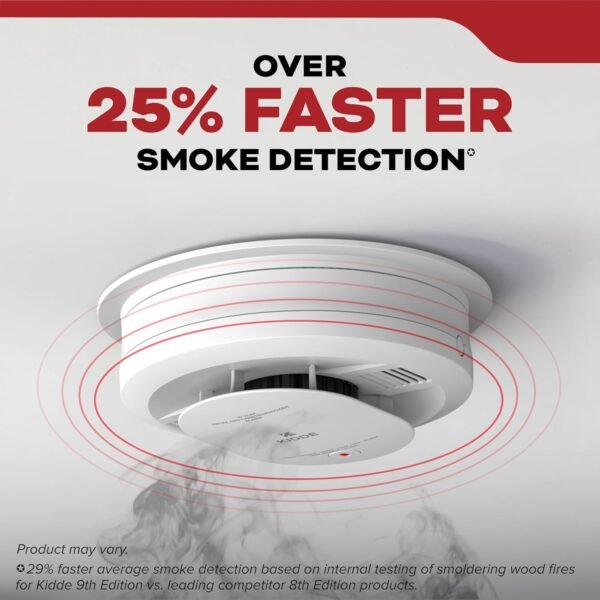
Kidde lists this alarm as UL 217 9th Edition certified and states that it meets FCC and CSFM requirements. Those are the listed markings for the model, and the marking on the unit itself is what counts if a specific edition matters in your jurisdiction. The 10-year limited warranty runs from the point the alarm is first powered, covering the same decade as the sealed backup cell. That is a longer warranty term than alarms built around replaceable batteries typically carry, because the manufacturer is warranting the cell as part of the unit. None of this replaces local building or fire code, an inspection, or the manufacturer’s own instructions on where alarms must be fitted.
Value Proposition: Is It Worth the Investment?
Priced against its feature set, the four pack is where this model makes its case. The 10-year backup alone removes a decade of battery purchases across four units, which is the running cost that a cheaper alarm quietly imposes. The interconnect is the other half, and it matters most in exactly the homes that need four alarms, larger footprints and multi-level layouts. The upfront cost sits above battery-only alarms, and the longer service life, mains power and nuisance-resistant sensing are what the difference buys. Comparable hardwired models such as the i4618 sit at a similar level within the same range.
Product Competitors: How Does It Stack Up?
Against First Alert and Nest Protect, a few differences stand out. The Kidde combination of mains power and a 10-year backup is not universal, and several competitors offer one or the other rather than both. Nest Protect adds smart home integration and phone alerts at a higher price and with shorter battery intervals. First Alert’s range includes more variation in alarm features, and the hardwired 9120B is the model most often cross-shopped against this one. Kidde’s interconnect works across other Kidde models, which suits buyers building a single-brand loop rather than a mixed one. Compatibility across brands is not a given and should be checked before mixing units.
Positive Features That Stand Out
- Ten year lithium backup removes battery changes across the rated life
- Interconnectable alarms sound together across the wired loop
- Self-test runs alongside the required weekly manual test
- Photoelectric sensing reduces nuisance alarms from cooking smoke
- Twist-and-click bracket simplifies the mechanical fitting
Areas for Improvement
- Installation is a wiring job that must follow local electrical code
- Limited visibility of LED status indicators at distance or in bright rooms
- Alarm volume is startling during routine testing
- No option to adjust sensitivity levels
On the published specifications, this four pack suits a household wiring a whole floor at once and wanting long-term reliability with fewer nuisance alarms. Installation is the real commitment, and once the loop is in place the maintenance drops to a weekly button test for a decade. Buyers weighing it against the rest of our smoke detector and fire alarm reviews are mostly deciding between a wired loop and a set of independent sealed battery alarms.