Description
Highlights of the Milwaukee Cordless Polisher 2438-20
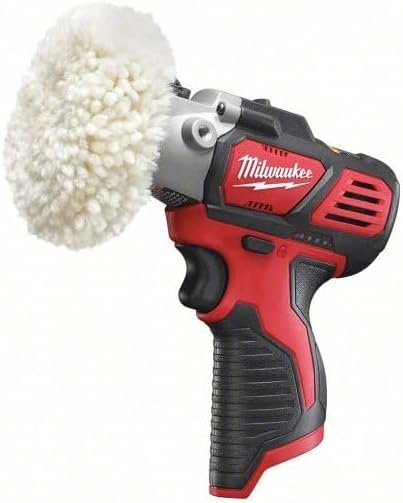
The Milwaukee Cordless Polisher 2438-20 ships as a bare tool with no battery included, so a compatible M12 REDLITHIUM pack has to be on hand or bought separately. The headline specification is the variable speed trigger, which covers 0 to 2800 RPM in polishing mode and up to 8300 RPM in sanding mode. That dual range is what lets one tool serve two jobs, buffing a car hood at the low end and sanding at the high end. Its compact body, just over five inches long, and a listed weight of around 1.6 pounds put it firmly in the one-handed class, which is the design intent behind the whole tool. The soft grip, nonslip handle supports that same goal: control during detail work where precision matters more than pad coverage.
Drawbacks That Stood Out
Against those specs, the bare-tool format is the first obstacle for anyone expecting a ready-to-run kit. The tool is also genuinely small, which caps its usefulness on larger projects or for professionals needing more pad area. The M9 x 0.75 spindle thread size narrows accessory compatibility to what fits that thread, a real constraint when sourcing replacement pads. The bundle covers the basics with backing pads in 3-inch and 2-inch sizes, a wool pad, and foam pads in yellow and white, though moving between sanding and polishing modes is a changeover rather than a flick of a switch. The recurring points are these:
- Requires separate battery purchase, which adds to overall cost.
- Small size limits heavy-duty applications.
- Accessory changes are tool-free but can feel fiddly.
- Spindle thread size restricts pad options somewhat.
Versatility and Features in Action
The tool-free accessory change is the feature that makes the dual-mode design workable, since no wrench is needed to move between the polishing backing pad and the sanding pad. On mixed work such as motorcycle panels and household furniture, that removes the main friction point. The supplied pad set covers three distinct roles, wool for cutting, yellow foam for polishing, and white foam for finishing, which is a sensible spread for a compact tool. The variable speed trigger ramps power progressively rather than snapping to full speed, and that ramp is what keeps swirl marks off paint. The sanding ceiling of 8300 RPM is fast for the size, though it still sits below corded polishers built for aggressive material removal. Larger corded and cordless options are collected in our polishers and buffers category.
User Experience and Handling
Buyer feedback centres on the same trait the spec sheet implies: the lightweight, compact form factor is what makes this tool viable in tight spots and for overhead work, where a full-size buffer is unusable. The side handle adds stability on curved surfaces, and the nonslip grip is specified to hold up when hands are damp. The trade is size, and the short body and slim grip can feel cramped for larger hands. Noise is another consequence of the small brushless-class motor: it runs quieter than typical corded polishers, which matters for indoor or noise-sensitive work. Buyers who need the same cordless convenience with real pad area should compare the Milwaukee M18 FUEL 7-inch variable speed polisher.
Product Comparisons With Market Rivals
Set against competitors such as the corded DEWALT DWP849X variable-speed buffer or the Bosch GPO 12 CE, the tradeoffs are clear. The Milwaukee wins on portability and battery compatibility inside the M12 ecosystem, which is decisive for anyone already holding those packs. The DEWALT is bulkier but reaches a higher no-load speed and appears in kits that include a battery and charger. The Bosch angle polisher is more powerful yet heavier and corded, which removes the mobility advantage entirely. For buyers who rank cordless convenience and moderate polishing power highest, the Milwaukee is the fit. Where raw power and uninterrupted runtime matter more, the corded field is ahead.
Price Worthiness and Value Proposition
Priced against other cordless polishers, this model represents decent value for money once an existing Milwaukee battery collection is factored in. It is not the cheapest bare tool available, but the build spec and included accessories account for the difference. The 5-year limited warranty is the clearest signal of the manufacturer’s own durability expectations. For casual users and hobbyists already on M12, it is a low-cost way to add a versatile tool without paying for a full kit. Starting from zero changes that arithmetic sharply, and bundled alternatives deserve a look at that point.
Good Aspects That Impress
- Lightweight and compact design enhances maneuverability.
- Variable speed trigger offers precise control for different tasks.
- Tool-free accessory change speeds up workflow.
- Multiple included polishing and sanding pads cover a range of applications.
- Compatible with the M12 REDLITHIUM battery system.
Limitations Worth Noting
- Battery sold separately, increasing overall cost.
- Smaller size might feel cramped for some users.
- Limited top speed for sanding compared to corded rivals.
- Spindle thread size limits accessory options.
- Accessory swaps, though tool-free, can be fiddly under time pressure.
Alternative Offerings in the Market
Among comparable cordless polishers, the DEWALT and Bosch models are the obvious contenders. The DEWALT line generally offers more power and appears in battery-inclusive bundles, which is the better route for buyers starting without any cordless platform, and the DEWALT DCM848B cordless variable-speed buffer is the direct cordless comparison. Bosch’s corded model delivers uninterrupted power at the cost of portability. The Makita BO6030 is another alternative with strong speed control and a slightly larger pad, though it is corded as well. The Milwaukee’s case rests on lightweight design and cordless operation within the M12 platform, and its weaknesses are the missing battery and the sanding speed ceiling.
Read across those competitors, this polisher suits buyers who value compactness and cordless flexibility over maximum power. For frequent small polishing and sanding jobs it is well matched on handling and features. Professionals working large surfaces will run into the power and pad size limits quickly, and a forced-rotation option such as the Milwaukee M18 FUEL 15mm random orbital polisher covers that ground better.