Description
Positive Features of the Milwaukee M18 Fuel 15mm Random Orbital Polisher
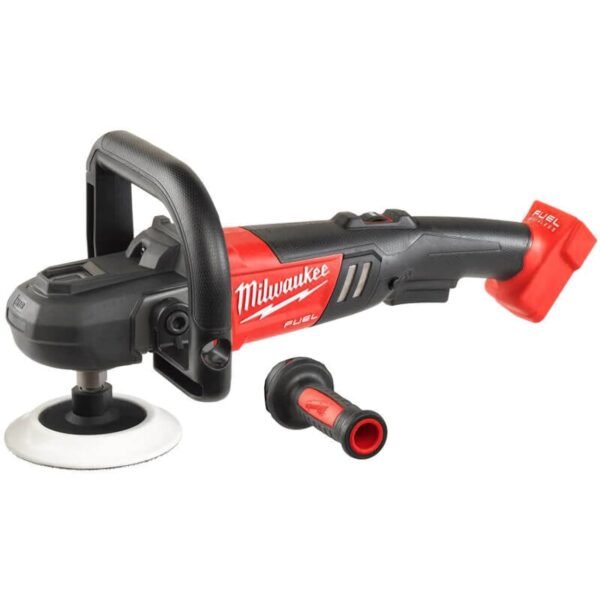
The Milwaukee M18 Fuel 15mm Random Orbital Polisher – No Charger, No Battery, Bare Tool Only is defined by its 8-speed dial, which spans 2,650 to 5,100 RPM. That range is the specification that lets one machine cover both light finishing and heavy defect correction rather than forcing a compromise setting. The variable speed trigger works alongside the dial for finer control, which is the feature that matters on delicate surfaces where the first pass decides the result.
The premium electronic motor feedback is the other core specification. It is designed to hold speed under load, avoiding the slowdowns that undermine cheaper polishers exactly when pad pressure increases. The lock-on switch addresses user fatigue on long sessions, a known pain point on car and boat work where the trigger would otherwise be held continuously. The stated optimized center of balance is what makes a 15mm throw machine manageable one-handed at the edges of a panel. Comparable machines sit in our random-orbit sanders category.
- Versatile speed settings for various polishing tasks
- Smooth motor feedback maintains consistent power
- Lock-on switch for fatigue-free operation
Drawbacks to Keep in Mind
Several limitations sit against that. As a bare tool only, it ships without a battery or charger, so compatible M18 batteries are a prerequisite or an additional purchase. For anyone new to the Milwaukee M18 system, the real entry cost is considerably higher than the tool price suggests.
Weight is the second issue. At roughly 6 pounds, it sits on the heavier side of the category, and buyer feedback consistently ties that to arm fatigue on long sessions even with the lock-on switch engaged. The 5-inch pad capacity is the category standard but caps how fast large surfaces can be covered. The angled design aids control while making tight spaces harder to reach.
- Battery and charger not included
- Tool weight can cause fatigue over long sessions
- Pad size may restrict work speed on big surfaces
Ergonomics and User Comfort
The ergonomic design is where the specification detail concentrates. The optimized center of balance is intended to stop the tool feeling front-heavy, the failure mode of older polisher layouts. The handle grip and the variable speed trigger are both sized for single-finger modulation, which is what gives usable control when polishing cars, boats, or furniture where an aggressive pass causes visible damage.
The tool lists about 2.21 inches of battery clearance, a specification that exists precisely to prevent the pack fouling bodywork when running close to edges or contours. The lock-on switch requires a deliberate press to engage, which is the design answer to accidental activation on a tool this powerful.
The red housing and alloy steel construction match the rest of the professional M18 line, and the material spec is what supports the durability positioning rather than the finish.
Performance on Heavy Defect Correction
The power to correct heavy defects is the clearest positioning statement in the spec sheet. Milwaukee has aimed this at users dealing with deep scratches, oxidation, and swirl marks in automotive paint, work that punishes tools which lose speed under pressure. The pairing of high RPM capability with premium motor feedback is exactly the combination that prevents that bogging down.
On older panels carrying visible swirl marks, that capability is what the 15mm throw is built to exploit. The 8-speed dial then allows the speed to be dropped for final finishing, which is how over-polishing is avoided. That two-ended range is what makes the tool workable for professionals and serious hobbyists alike, and the pad choice matters as much as the machine: the Venom Web diamond polishing pad set shows how much the abrasive stage affects the result.
Product Comparisons
Against popular models such as the corded DEWALT DWP849X variable-speed buffer or the Makita 9237CX3 7-inch polisher kit, the Milwaukee’s advantage is battery compatibility across the wider M18 line, which is decisive for existing Milwaukee owners. The motor feedback system is more advanced on paper than several competitors, holding power better as load increases.
Against that, the weight is higher than the Makita, which is easier to hold through a long session. The DEWALT covers similar speeds and frequently ships with a battery and charger, a better entry package for a first-time buyer.
This polisher’s strength is power and control, which suits heavy-duty correction work, while the alternatives fit quick, light buffing better. The ergonomic design and lock-on switch add to the comfort case over long jobs.
Value Assessment
The bare-tool price makes sense for buyers already holding Milwaukee M18 batteries or committed to the platform. Weighed against the motor, speed settings, and build durability, the price to quality ratio is strong for anyone who needs a polisher at this capability level.
Buyers who want a low price and do not need the extra power or electronic feedback have cheaper options available. For serious users the feature set carries the cost. Compatibility across the M18 battery and charger range adds practical value, since packs move between tools in an existing collection. The rotary alternative on the same platform is the Milwaukee M18 FUEL 7-inch variable speed polisher.
Versatility and Settings
Adjustability is the strongest part of this specification. The 8-speed dial covers a broad spectrum, from a careful 2,650 RPM to a robust 5,100 RPM, which is what allows the same tool to handle different materials and correction stages. The variable speed trigger layers finer control on top of that, and on delicate finishes that second layer is what prevents damage.
The battery-powered design removes cords from the workflow, which is a practical gain when moving around a vehicle or working outdoors away from an outlet. Despite the power rating, the tool keeps a manageable size and ergonomic profile, which keeps it viable for automotive and home improvement work alike.
Durability and Build Quality
The build specification is solid throughout. Alloy steel and metal components are what back the claim that the tool withstands job site conditions, and Milwaukee’s durability reputation in this line rests on that material choice rather than on styling.
The bare tool design keeps bulk down and shifts battery management to the owner. The red casing is practical as much as visual, making the tool easy to identify on a crowded bench. On the published specification, this is a polisher built to run through repeated projects, from paint restoration to buffing scratches out of household furniture.
Taken as a whole, the Milwaukee M18 Fuel 15mm Random Orbital Polisher is a powerful and precise tool with clear trade-offs in weight and starting cost. It is aimed at users who need high performance and are already invested in the Milwaukee ecosystem.