Description
Highlights of the Makita Pneumatic Siding Coil Nailer
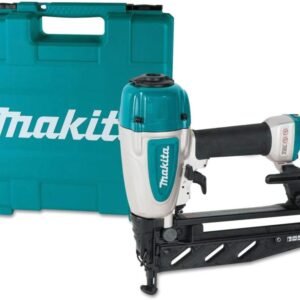
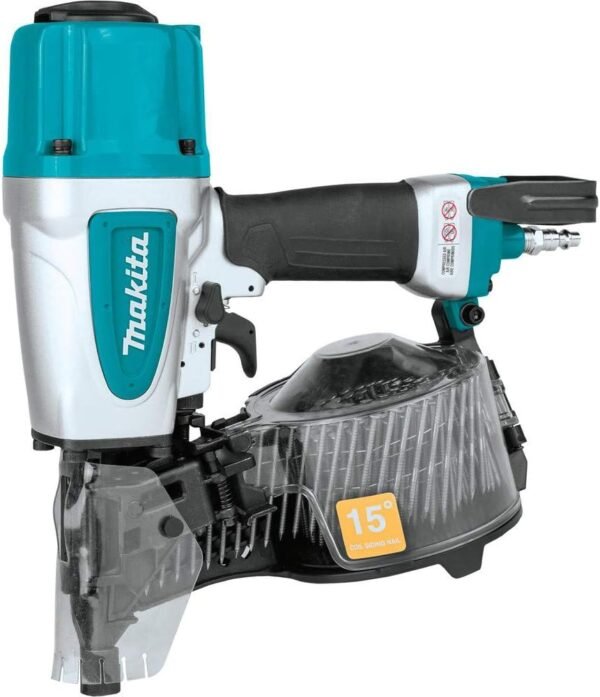
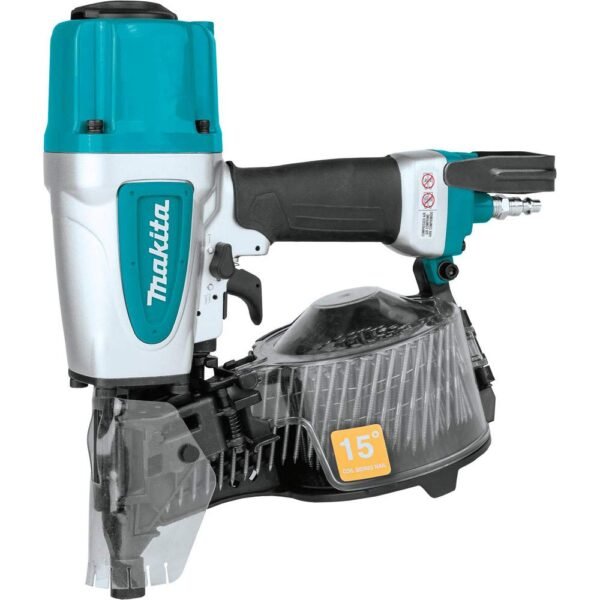
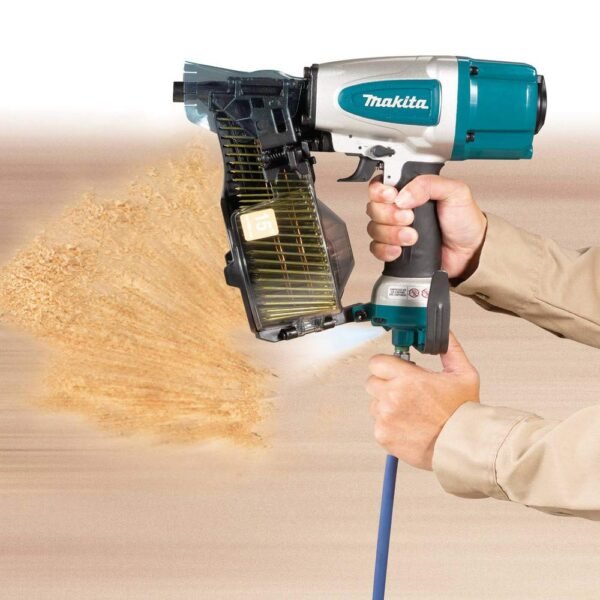
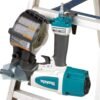
The Makita AN613 Pneumatic 15° 2-1/2″ Siding Coil Nailer leads on a handful of specifications. Makita credits the efficient motor and trigger design with fast and consistent nailing performance, the pairing that matters on siding and roofing runs where the pace of the wall sets the pace of the tool. The tool-less depth adjustment carries nine detent settings, enough resolution to place a head flush on one course and countersunk on the next without reaching for a wrench.
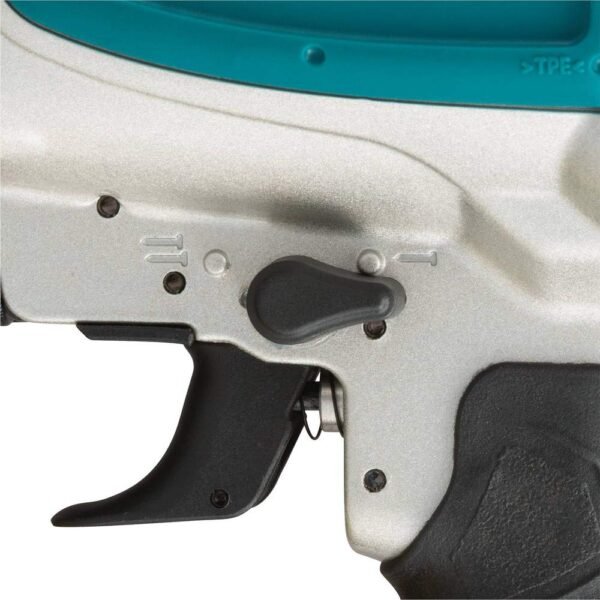
The two-mode selector switch is the second headline feature, toggling between contact and sequential nailing modes so the firing style follows the task rather than forcing a compromise in tight corners or along long stretches. The tool also drives both 15° wire and plastic collated nails, which widens the range of fasteners a crew can buy locally.
Design and Build Quality
The lightweight aluminum housing is the structural choice behind the listed handling: aluminium keeps mass down without the flex of a plastic-heavy body. Rubber bumpers ring the tool to absorb impacts and limit scratches and dings, a sensible provision for a nailer that spends its life on scaffold planks and sheathing. The smooth nose tip is specified to avoid marking delicate siding or trim, which matters wherever the finished face stays visible.
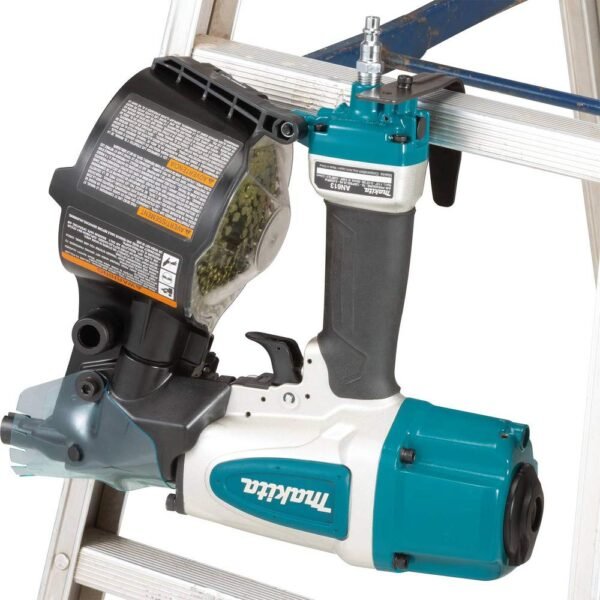
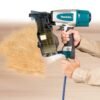
A multi-directional exhaust port aims the air blast away from the operator and away from nearby surfaces, and the reversible belt hook mounts on either side for left or right-handed carry. The design reads as a tool for professionals and committed DIY users who spend sustained time on roofs and exterior walls.
Performance and Driving Characteristics
The specification points to solid power and repeatable placement. A fast cycling rate is what keeps a coil nailer viable in dense materials such as cedar and fiber cement siding, where a slow reset costs more time than the fastener itself. The trigger response is tuned for control rather than a hair release, and the depth adjustment is the control that produces a countersunk head without extra passes.
Switching between the contact and sequential modes is a single selector movement, with contact mode suited to rapid field nailing and sequential mode to work that needs each fastener placed deliberately. The tool handles nail lengths up to 2-1/2 inches, which covers roofing, siding, and exterior trim applications on one platform. Buyers cross-shopping this against interior trim tools can browse the finish nailers category.
Limitations and Downsides
Several areas fall short of the class leaders. The weight of 4.84 pounds sits on the heavier side against lighter coil nailers, and the difference concentrates in the wrist during prolonged use. The loading mechanism is adjustable rather than automatic, so setting the canister for a new nail length is a deliberate step and takes some familiarity before it becomes quick.
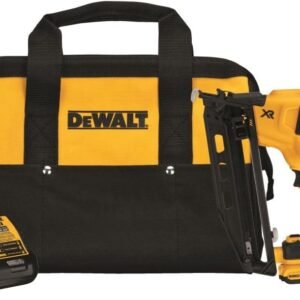
There is no battery or cordless option in this line, which means a compressor and hose are part of the setup on every job and portability is limited accordingly. The price point also leans premium, placing the tool outside the range most casual users and hobbyists will consider. A cordless finish tool such as the DEWALT DCN660 20V MAX XR cordless finish nailer answers the hose question, though in a different fastener class.
Value Assessment
Weighed on build quality, performance, and feature set, the Makita siding coil nailer presents a solid value proposition for professionals who need reliability and repeatable placement. The three-year limited warranty is the manufacturer’s own statement of confidence in the tool’s durability. The investment sits above entry-level models, but the versatility with nail types and adjustable settings is what justifies the difference for frequent users.
For a robust tool covering roofing and siding tasks on one platform, the combination of power, control, and considered ergonomics is where the money goes. Casual users will find better cost-efficiency further down the range, and a compact pneumatic such as the Makita AF601 finish nailer covers indoor work at a lower entry price.
Drawbacks and Areas for Improvement
- The weight can be tiring during extended use, especially overhead.
- No cordless option restricts mobility on larger job sites.
- The loading system requires a learning curve and can slow work initially.
- Higher price point might deter occasional users or DIYers.
Product Comparisons
Against popular siding coil nailers such as the Bostitch RN46-1 or the Hitachi NV45AB2, this model competes on precision and versatility. The tool-less depth adjustment with nine detents publishes finer control than rivals that offer a handful of settings. Acceptance of wire and plastic collated nails is the second differentiator, since some competing tools restrict collation type.
Working the other way, rivals including the Bostitch are listed lighter and some lines offer cordless options, which are the better fit for prolonged or remote work. Hitachi’s models publish faster loading arrangements and slightly lower weight, so portability and quick reloads point toward them.
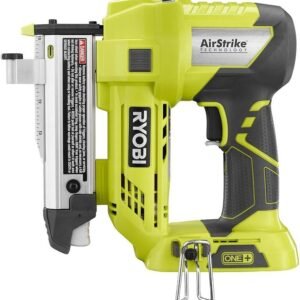
The Makita’s strengths concentrate in durability and exhaust management, with the multi-directional port reducing the air blast that makes long pneumatic sessions unpleasant. The tool fits the professional segment, aimed at buyers who rank precision nailing and tool longevity above the lightest possible body. Anyone whose work runs to interior trim instead will find the Ryobi P318 cordless finish nailer a closer match on both weight and fastener size.
Ease of Use Features
The intuitive controls keep setup and operation short. The depth adjustment knob requires no tools, so changes happen on the wall rather than at the truck. The reversible belt hook mounts on either side, and the multi-directional exhaust removes the constant dodging of air blasts that comes with fixed-port pneumatics.
The trigger design and the two firing modes together let the tool be matched to the task at hand. Contact mode supports rapid-fire nailing across broad surfaces, while sequential mode restores control on delicate trim work. These are the features that address the usual frustrations of pneumatic nailers rather than adding to them.
Final Thoughts on Usage and Practicality
As part of a job site kit, this siding coil nailer is specified to balance power against control. The smooth nose tip is the detail that protects visible surfaces, which is what finish work demands. The aluminum housing is the structural argument for longevity over plastic-heavy models that wear at the mounting points first.
The inclusion of safety glasses and an air fitting in the package means the tool is ready to connect out of the box. Weight and the corded pneumatic format will rule it out for some buyers, but on the published specification it delivers on durability, adjustable precision, and consistent nailing. For a lighter interior alternative on the same bench, the Senco FinishPro 18 brad nailer covers the 18-gauge end of the same fastener spectrum.