Description
Published Specification of the Fenix LR40R Rechargeable Searchlight
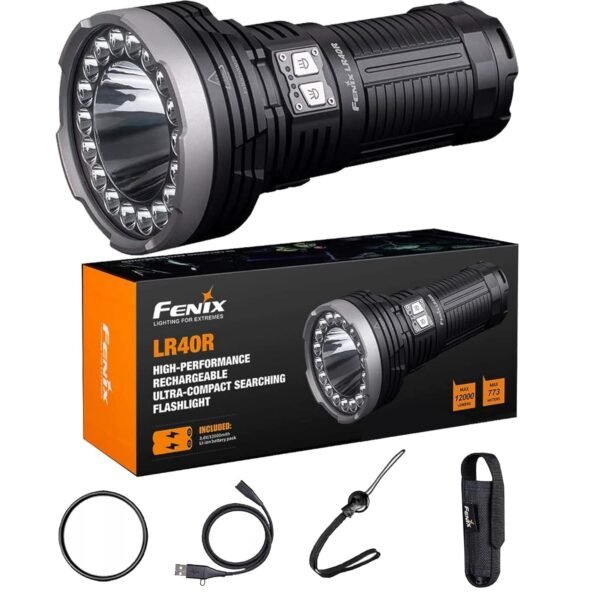
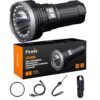
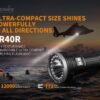
The Fenix LR40R Rechargeable Search Torch in black is specified at a 12,000 lumen maximum output across a dual-beam layout. Published dimensions are 154mm long with an 80mm head diameter, and listed weight is about 500 grams. The listing calls the light ultra-compact and tiny, and those adjectives do not match the numbers printed beside them: an 80mm head and half a kilogram place this squarely in the searchlight class, not the handheld class, where a duty light typically runs 25 to 40mm at the head and 150 to 250 grams. The dimensions are the honest guide, and buyers expecting something pocketable from the marketing language should reset that expectation before ordering.
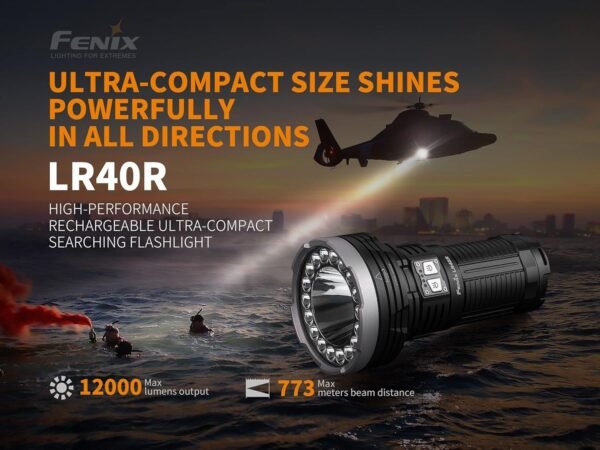
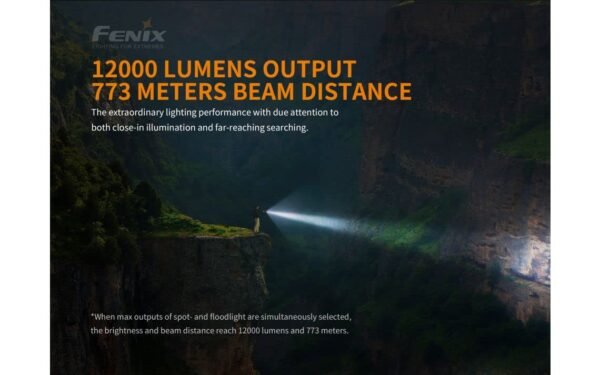
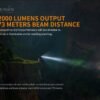
The dual-beam system is the design centre. A spotlight channel produces 1,000 lumens with a 640 meter beam range, and a floodlight channel reaches 11,000 lumens at 410 meters; run together they give the headline 12,000 lumens and a 773 meter range. Those figures reconcile properly against each other under the standard beam distance relation, which is worth saying because published searchlight numbers often do not. The tradeoff they describe is real: the narrow channel buys distance from a tenth of the output, and the wide channel buys area coverage from nearly all of it.
- 12,000 lumen combined maximum across two independent beam channels
- Spotlight at 1,000 lumens and 640 meters, floodlight at 11,000 lumens and 410 meters
- USB-C charging with a published power bank discharge function
- IP68 rating quoted at up to 2 meters of immersion
Where the Headline Figure Needs Qualifying
The most important limitation is thermal rather than electrical. The listing states that the 11,000 lumen floodlight setting holds for roughly two minutes before the light steps down to protect itself, and the combined 12,000 lumen mode carries the same constraint. That means the number in the product name is a burst rating, not a runtime rating. Nothing about that is unusual for the output class, and it is not a fault so much as physics, but it does mean the specification most buyers shop on is the one they will see for the shortest time. The sustained figure that matters is whatever the light settles to after step-down, and the listing does not publish it.
The 500 gram weight is the second constraint, and it is a direct consequence of the head diameter and the cell inside. Extended handheld carry is tiring at that mass, which is why a holster is included rather than offered separately. The supplied lanyard is thin relative to the weight it is asked to hold. The battery indicator LEDs only report with the light switched off, so checking remaining charge means interrupting use, which is a genuine interface limitation on a light bought for search work.
- Maximum floodlight output holds for roughly two minutes before thermal step-down
- 500 grams is heavy for sustained handheld use
- Battery level cannot be read while the light is running
- Lanyard is light for the mass of the head
Beam Behaviour and Output Levels
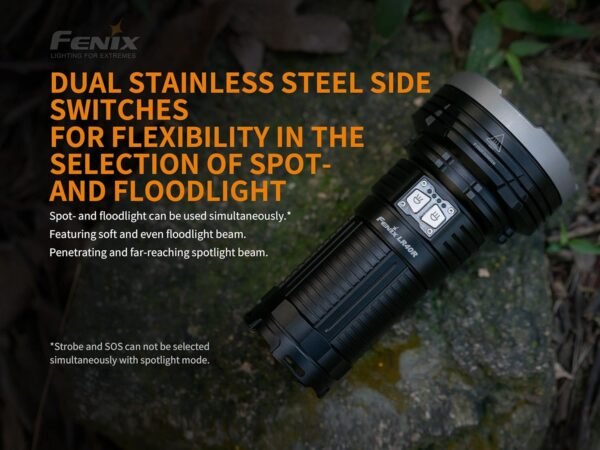
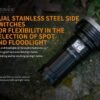
The spotlight channel offers four brightness levels and the floodlight channel five, with strobe and SOS included in the floodlight set. Lower levels are where the runtime lives, and on a light with this cell capacity the low settings run for many hours rather than minutes. The lockout function, engaged by holding both buttons for three seconds, addresses the specific risk of a high-output light activating inside a bag, which at 11,000 lumens is a heat problem and not merely a flat battery. The two stainless steel switches are specified for tactile feedback with gloves, which is the practical reason a searchlight uses metal buttons rather than a rubber boot.
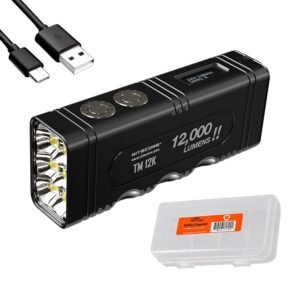
The spot channel produces a defined centre with a clean cutoff, which is what a 640 meter figure requires. The flood channel produces a broad wash that suits area work at close and medium range despite the published 410 meter number, since a wide beam that reaches 410 meters at its centre still spreads most of its output much closer. Buyers who want the same output philosophy in a handheld body rather than a searchlight will find the Nitecore TM12K at a rated 12000 lumens is the closest comparison on paper.
Build, Sealing and Materials
The body is black anodized aluminum, machined around the two-channel head. Sealing is certified to IP68 with a quoted 2 meter immersion depth, which is one of the few ratings in this segment that comes with a depth figure attached rather than a bare claim of waterproofing. That distinction matters: a published depth is a tested condition, while an unqualified waterproof description is not. The included holster is the intended carry method given the mass, and belt or pack mounting is more realistic than pocket carry.
The switch placement and the head geometry mean the light is operated two-handed as often as one-handed, which is normal for the class. Buyers who want an aluminum-bodied light they can actually pocket should look at a different size bracket entirely, such as the Fenix PD36R rechargeable everyday carry light from the same brand.
Battery, Charging and Power Bank Function
Power comes from the Fenix ARB-L37-12000 pack at a listed 12,000mAh, charged over USB-C with a quoted 3.3 hour fast charge when paired with a QC3.0 capable source. The pack also supports USB discharge, so the light doubles as a power bank for a phone, which is a meaningful inclusion on a light carried for emergencies rather than a gimmick. Runtime varies enormously by mode, from many hours on low spotlight settings to minutes at combined maximum, and the thermal step-down described above complicates any simple runtime figure at the top of the range. Lights that offer both a rechargeable pack and a primary cell fallback, such as the Nitecore P20iX with its CR123 battery magazine, hedge that risk differently.
How It Compares in the Searchlight Class
Against the Olight X7R Marauder and the Acebeam X70, the LR40R is the smaller and lighter package at comparable output, which is the reason the compact language appears in the listing even though the absolute numbers are not compact. The Olight holds a longer sustained turbo period in a larger body. The Acebeam pushes output higher and is heavier again. The dual-beam layout is the LR40R’s genuine point of difference, since most rivals commit to a single beam profile and ask the buyer to choose. The IP68 depth rating is at or above what most of the class publishes. Where competitors win is sustained output and charge speed, and both of those come with size or price attached.
Value and Who the Specification Suits
The price is high against basic flashlights and reasonable against searchlights with comparable output and sealing. The combination that justifies it is the two-channel head, the rated immersion depth and the pack that also charges a phone. What it does not buy is sustained maximum output, and any buyer whose actual need is continuous high output for more than a couple of minutes is shopping for the wrong tool at any price. For contractors, search work, marine use and vehicle carry where mass is acceptable, the sheet holds up. For area lighting at a campsite, a dedicated lantern such as the Fenix CL27R rechargeable lantern covers the job with far less power and heat. The rest of the range sits in the tactical flashlight and weapon light category.
The published specification describes a capable dual-beam searchlight whose internal numbers agree with each other, wrapped in listing language that oversells its size. Read the dimensions rather than the adjectives, treat 12,000 lumens as a two minute figure, and the product matches its description.