Description
Highlights of the Kidde Hardwired Smoke Detector
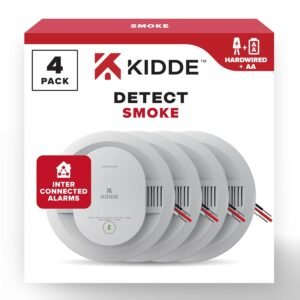
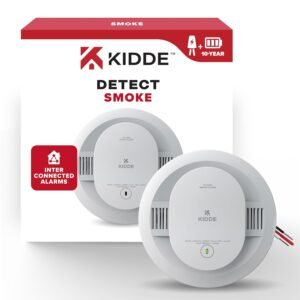
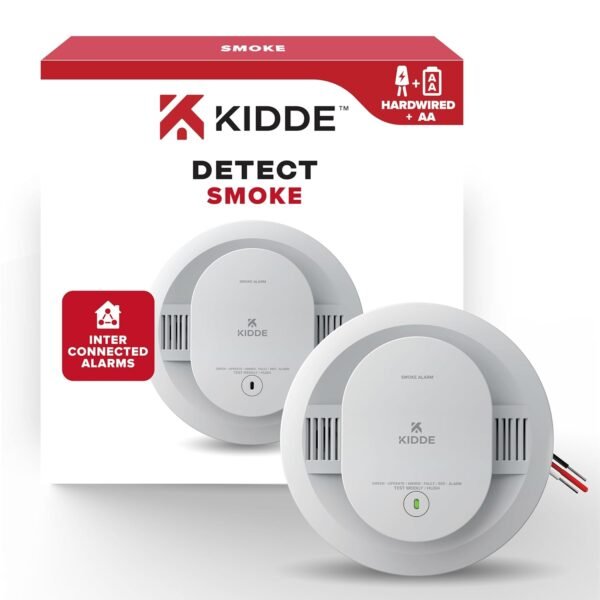
The Kidde Hardwired Smoke Detector, AA Battery Backup, Interconnectable, LED Warning Light Indicators (model 20SAR) is a mains powered residential smoke alarm with a wired interconnect. The 85-decibel alarm is the output level residential alarms are built around, and the listing describes the alert pattern as 3 long beeps with a red LED flashing in time, repeating. The combination of hardwired power with 2 AA alkaline battery backup is what keeps the alarm working through a mains outage. Kidde credits the enhanced sensing technology with cutting the nuisance alarms that cooking smoke sets off. The interconnect capability is the feature that matters most in a multi room house, since one alarm sensing smoke sounds every unit wired into the same loop, an arrangement that also accepts interconnect accessories such as the Kidde SM120X relay module.
- Loud 85-decibel alarm with LED indicators
- Hardwired with battery backup so the alarm stays powered in an outage
- Enhanced sensing technology aimed at cooking and steam nuisance alarms
- Interconnectable with compatible alarms on the same loop
Drawbacks Worth Considering
Some parts of the specification will not suit every buyer. The installation process is not plug-and-play. The twist-and-click mounting bracket simplifies the physical fixing, but connecting the unit to the ceiling’s 120V AC supply is electrical work that has to follow local electrical code and, for most households, a qualified electrician. The second point is the battery replacement frequency. Kidde specifies swapping the two AA cells every six months, which adds up across several units, so buyers who want less upkeep tend to look at a sealed cell design such as the hardwired Kidde i12010S with its 10 year battery backup. The LED indicators are useful once learned, but the green, amber and red states take a little reading before the status is obvious at a glance.
- Installation is electrical work and may require a qualified electrician
- Batteries must be replaced every six months
- LED light indicators can be confusing initially
Design and Build Quality Insights
The 5-inch circular design sits flat against a ceiling without dominating the room. Its white plastic casing is the standard finish for the category, and at just under a pound the unit is light enough to hang from the supplied bracket. The listing gives a photoelectric sensor, the type that tends to respond earlier to smoldering fires than to fast flaming ones. Published environmental limits run to 95% relative humidity and temperatures up to 100 degrees Fahrenheit, which covers hallway, bedroom and kitchen adjacent positions, though how many alarms a house needs and where they belong are code questions rather than preferences. Buyers who want the same round footprint in a smaller battery only package usually compare it with the compact Kidde i9040. Mounting hardware and a user guide are in the box, and Kidde’s own instructions take priority over any general guidance.
Features and Functionality
Day to day operation centers on the test and hush button, which both verifies the horn and temporarily quiets a nuisance alarm without pulling the battery. The self-testing internal components monitor the unit continuously, though a self-test is not the same thing as a manual push test of the horn. The LED behavior gives a visual channel alongside the sound, which is worth having in a household where someone sleeps through tones. The interconnect feature is the reason the model is sold in multiples, since smoke starting in a garage or basement is only useful information if the bedrooms hear about it.
Alternative Offerings in the Market
Set against smart alarms such as Nest Protect, or against First Alert’s hardwired range, the differences are structural rather than marginal. The Kidde unit is hardwired with battery backup, a combination many connected detectors skip in favor of batteries or Wi-Fi alone. It does not offer smartphone alerts or spoken warnings. The photoelectric sensor technology is the same sensing type used across much of the category, while some competitors run dual sensor detection, pairing photoelectric with ionization to cover both smoldering and fast flaming fires. On false alarms, the enhanced sensing technology is aimed squarely at the kitchen problem that drives owners of cheaper units to disable them. Battery life is where several rivals pull ahead, and Kidde’s i12060A hardwired alarm is the closest in house comparison for anyone weighing the two.
Value Assessment of the Smoke Detector
On specification alone the unit covers the fundamentals: hardwired installation with battery backup, interconnectivity, and the UL 217 9th Edition compliance Kidde states for the model. It carries no smart home integration and no dual sensor. Batteries are included, and the listing gives a 10-year limited warranty on the alarm. For a buyer who wants a straightforward wired alarm rather than a connected one, the trade is upkeep every six months in exchange for a lower price, and that same trade shows up across the rest of our smoke detector and fire alarm reviews.
Positive Features That Stand Out
- Hardwired power with AA battery backup keeps the alarm running through an outage
- Interconnected alarms sound together when one unit detects smoke
- Enhanced sensing technology targets the cooking smoke behind most nuisance alarms
- Test and hush buttons make routine checks and nuisance silencing straightforward
Areas for Improvement
- Installation is 120V wiring work and may require an electrician
- Battery replacement every six months could be inconvenient for some users
- LED indicator colors require familiarization to quickly interpret alarm status
- Lacks smart features like mobile alerts or voice notifications found in some rivals
The 20SAR reads as a conventional wired alarm rather than a connected one. The sensing, the interconnect and the backup cell are the whole proposition, and the cost of that simplicity is the six month battery cycle plus an install that belongs to an electrician rather than to a weekend afternoon.