

Description
Powerful Performance with RIDGID 15 Degree 1-3/4 in. Coil Roofing Nailer
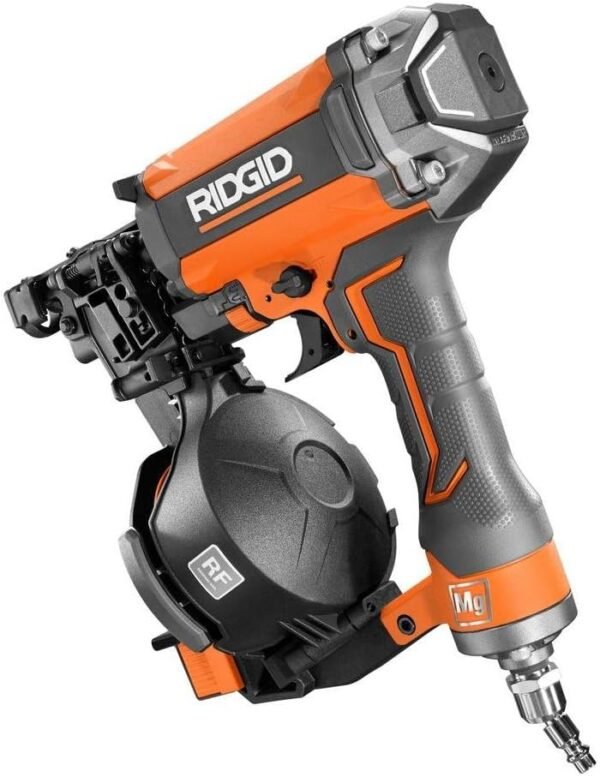
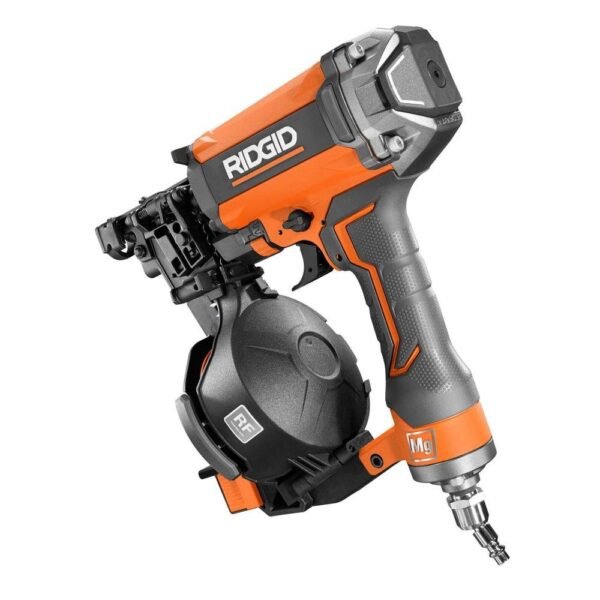
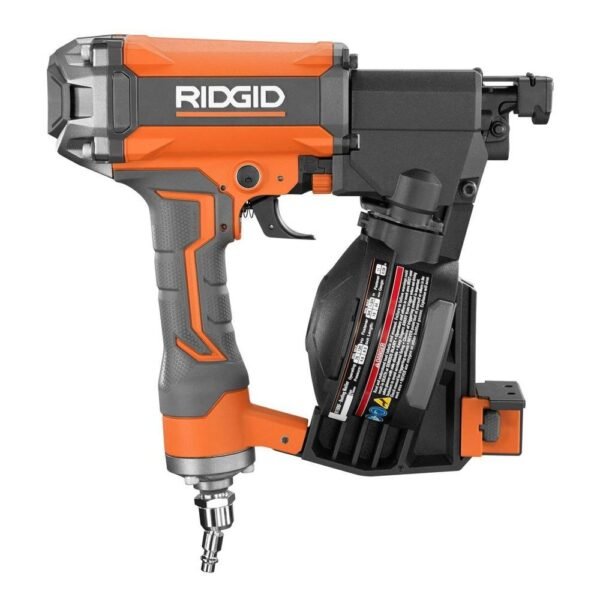
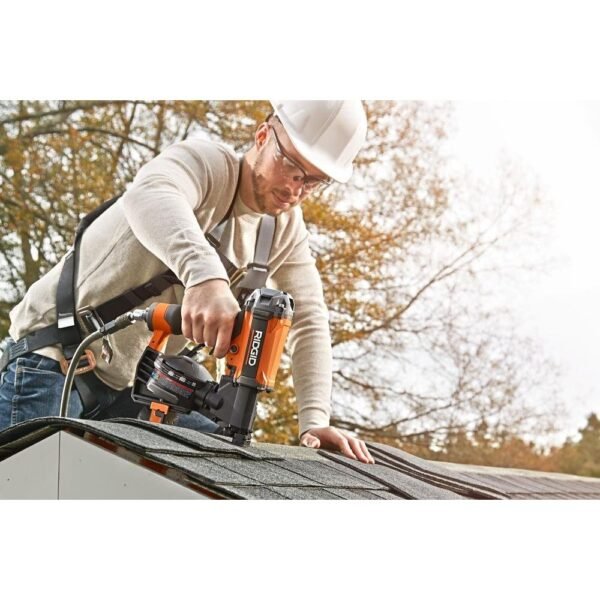
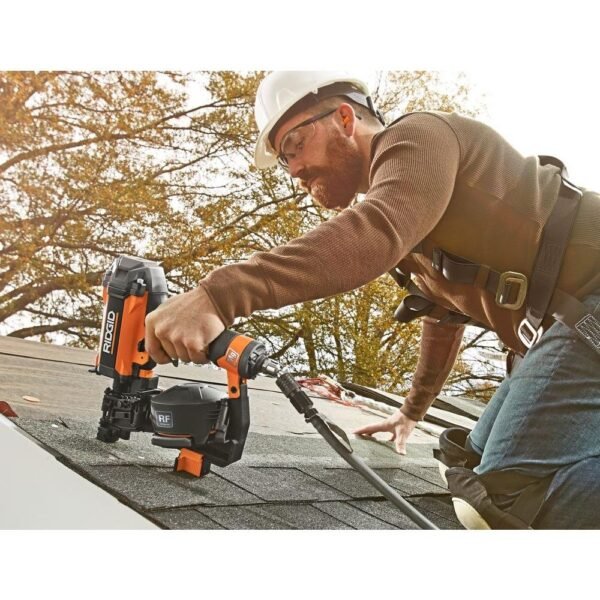
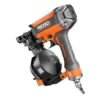
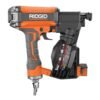
The RIDGID 15 degree 1-3/4 in. Coil Roofing Nailer is specified around three things at once: power, weight, and speed. Fasten Edge Technology is the feature RIDGID promotes for placement accuracy at the shingle edge. The straight drive design is intended to seat nails flush, which is what keeps shingle damage down and gives a roof the finish a customer is paying for. Ergonomics get equal billing in the manufacturer’s description, with the tool positioned as balanced enough for extended runs rather than merely powerful.
Highlights: What Makes This Roofing Nailer Stand Out
- EZ load feature that simplifies loading the nail coil, cutting the time lost between courses.
- Dry-fire lockout mechanism to protect the driver and prevent wasted strokes.
- Exhaust diffuser with muffler that directs exhaust away from the face, which is a comfort feature that earns its place on a hot roof.
- Listed weight of 4 pounds, positioned as a maneuverability advantage.
- Service agreement covering free replacement of o-rings, piston stops, and driver blades for the life of the tool.
Those specifications target the parts of roofing that waste the most time. The dry-fire lockout stops the tool cycling on an empty magazine, a common source of driver wear on nailers that lack it. The exhaust muffler is a small feature with a real effect on a crew working shoulder to shoulder in still air.
Drawbacks: Some Things That Could Be Better
- Coil capacity trails some competitors, which means more reloads across a large roof.
- The exhaust muffler cuts noise but does not eliminate it, so hearing protection is still required.
- No battery is included or required. That suits crews already running air, but rules out cordless portability.
- Nail length is fixed at 1-3/4 inches, so it will not cover jobs that call for a different fastener length on the fly.
Listing data is also worth a second look on size and mass: the stated 4 pounds is at the very light end for a full-size coil roofing nailer with packaged dimensions of 13.94 x 5.25 x 12.25 inches, so the two figures do not sit comfortably together. Either way, the housing is on the bulky side for work tight against edges, valleys, and corners, which is the trade for its solid build.
User Experience: How It Feels on the Job
For a roofer, the features that matter day to day are the ones tied to pace. The straight drive setting nails flush reduces the touch-up work that otherwise piles up at the end of a course. The dry-fire lockout is a safety-adjacent feature as much as a maintenance one, since it stops the tool firing once the coil runs out. The EZ load system addresses the task that quietly consumes the most time over a long day, which is getting coils in and seated correctly. Comparable tools in the same class are laid out across the roofing nailers we cover.
Alternative Offerings: Comparing to Other Roofing Nailers
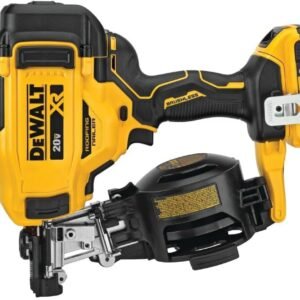
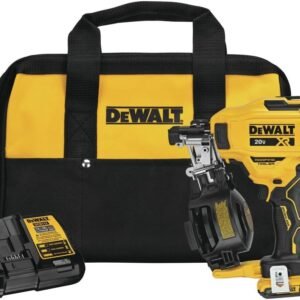
Against competitive options such as the Bostitch RN46-1 or the Hitachi NV45AB2, this coil nailer holds its position. Its service agreement is the clearest advantage, since free wear-part replacement is not something most rivals match. The Bostitch is lighter on paper with a larger magazine, but it goes without the same exhaust muffling and straight drive arrangement. The Hitachi carries a higher price with cordless variants available for crews that value mobility over air supply. The cordless comparison worth making directly is the DEWALT DCN45RND1 cordless roofing nailer, which drops the compressor entirely, while the BOSTITCH MCN150 metal connector nailer covers the strap and hanger fastening that often runs alongside a reroof.
Value Proposition: Is It Worth the Investment?
On price to quality ratio, this roofing nailer makes a straightforward case. Durability backed by the lifetime service agreement means the purchase includes ongoing parts support, which changes the arithmetic for anyone using the tool professionally. Cordless models offer more freedom of movement, but consistent air power and simple mechanics keep this pneumatic nailer relevant wherever compressors are already standard kit. Its cost-effectiveness comes from reduced downtime through the EZ load and dry-fire lockout features rather than from a low sticker price alone. Crews running the same compressor for siding can pair it with the Makita AN611 siding coil nailer.
Design and Build Quality: Tough and Thoughtful
The construction is specified as robust without pushing the weight up, which is a difficult balance in a tool that drives this hard. The exhaust diffuser with muffler redirects air away from the operator, reducing distraction over long shifts. The listed 4-pound weight is the figure RIDGID leads with for handling, and the overall dimensions reflect a tool built around a full coil rather than a compact magazine. The coil housing simplifies loading, and the 1-3/4 inch nail size matches standard asphalt shingle work.
Maintenance and Service: Industry-Leading Support
Serviceability is where this tool separates itself, largely through RIDGID’s free replacement policy for o-rings, piston stops, and driver blades. Those are precisely the parts that wear on a pneumatic nailer, so covering them removes the running cost that usually accumulates over years of use. Routine maintenance is conventional: oiling, cleaning, and periodic seal checks, with no special procedures called out in the documentation. The dry-fire lockout contributes here as well by reducing driver wear. Support of this kind is uncommon in the category and is a legitimate reason to shortlist the tool. For framing work on the same compressor, the NuMax SFR2190 pneumatic framing nailer covers the structural side of a build, alongside the rest of our framing nailer coverage.
Final Thoughts on Practical Usage
Read from its specification sheet, this coil roofing nailer is a dependable pneumatic tool with an unusually strong support commitment behind it. The balance of driving power and workflow features keeps attention on placement rather than on the tool itself. It is not without limits, with noise and coil capacity the two most cited, but the positives outweigh them for most roofing professionals. Across residential and commercial roofing, the feature set matches what the work actually demands, combining efficiency, safety, and durability in a single package.